Nepenthes muluensis M. Hotta
Species sheet, updated on 29/10/2026.
At a glance
| Scientific name | Nepenthes muluensis Mitsuru Hotta, 1966 |
| Common name | In French “népenthès du Mulu” |
| Family | Nepenthaceae |
| Distribution | Mounts Mulu, Api, Murud and Bukit Batu Lawi (Sarawak), south-western Sabah |
| Habitat | Open mossy forest and ridge vegetation, from about 1,700 to 2,400 m |
| Status | Least concern (IUCN, 2018) |
Etymology
- Nepenthes: see the genus sheet.
- muluensis: “from Mount Mulu”, where it was thought to be endemic.
History of the discovery
- 18 March 1964: the Japanese botanist Mitsuru Hotta collected it on the west ridge of Mount Mulu (Sarawak); the specimen is kept at Kyoto University.
- 1965: B. E. Smythies mistook it for N. gracillima.
- 1966: Hotta described it. It was the first Nepenthes described in 26 years, and the first after the Second World War.
Description (how to recognise it)
- A climber up to 4 m.
- Lower pitchers: up to 7 cm; upper pitchers: up to 10 cm, with two ribs instead of wings.
- Colours on the Mulu: dark purple pitchers speckled with yellow (lower) or yellowish-white (upper), often with a white peristome and lid. On the Murud, they are darker.
Distribution
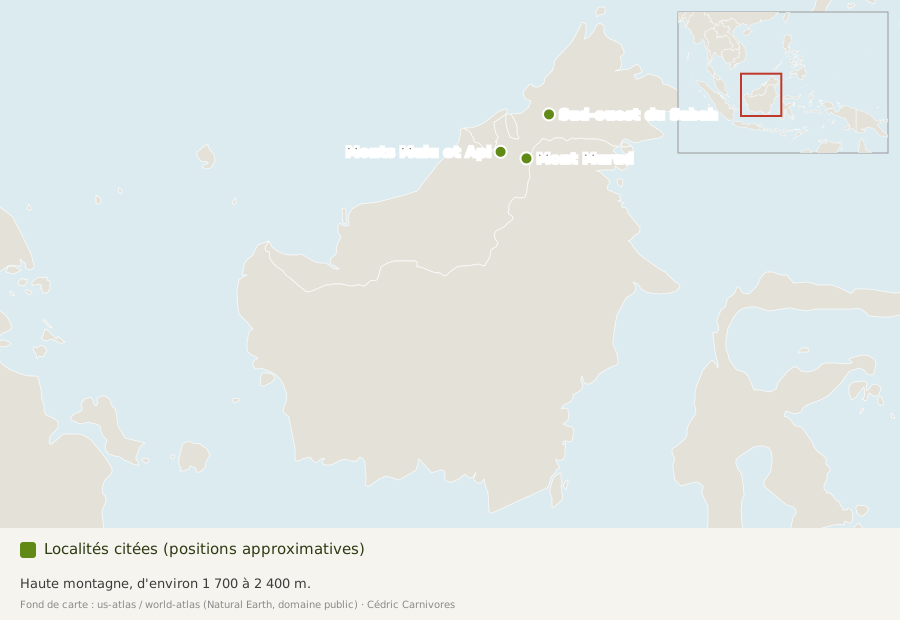
Endemic to Borneo: Mounts Mulu, Api, Murud and Bukit Batu Lawi in Sarawak, and south-western Sabah. From about 1,700 to 2,400 m.
Habitat
High-mountain zone: open mossy forest and ridge vegetation, on poor soils. It is most abundant in the summit heath forest of Mount Mulu.
Relationships
hamata group; it is mostly confused with N. tentaculata.
Natural hybrids
With N. lowii; with N. tentaculata (N. × sarawakiensis, disputed).
Threats and protection
“Least concern” according to the IUCN (2018), after “endangered” (1995) and “vulnerable” (2000).
Sources
- Wikipedia (English), Nepenthes muluensis: Hotta 1964/1966, first species in 26 years, description, colours, range, altitude, habitat, relationships, hybrids, successive statuses.