Nepenthes neoguineensis Macfarl.
Species sheet, updated on 30/10/2026.
At a glance
| Scientific name | Nepenthes neoguineensis John Muirhead Macfarlane, Nova Guinea 8, 1911 |
| Family | Nepenthaceae |
| Distribution | All of New Guinea and the D'Entrecasteaux Islands |
| Habitat | Riverbanks, gravel bars, ridges, from sea level to 900 m (sometimes 1,400 m) |
| Status | Least concern (IUCN) |
Etymology
- Nepenthes: see the genus sheet.
- neoguineensis: “from New Guinea”.
History of the description
- 1828: Alexander Zippelius collected it near Triton Bay.
- 1907: Gerard Versteeg collected the type specimen.
- 1910: Knud Gjellerup collected a male specimen at Hollandia (Jayapura).
- 1911: description by Macfarlane.
Description (how to recognise it)
- A climber with a stem up to 6 mm thick; leaves up to 25 cm by 4.5.
- Lower pitchers from light green to dark purple.
- Yellowish-green upper pitchers, with a bright red lid and fringed wings up to 8 mm.
- Glandular zone on the lower third of the pitcher, with 700 to 900 glands per cm².
Distribution
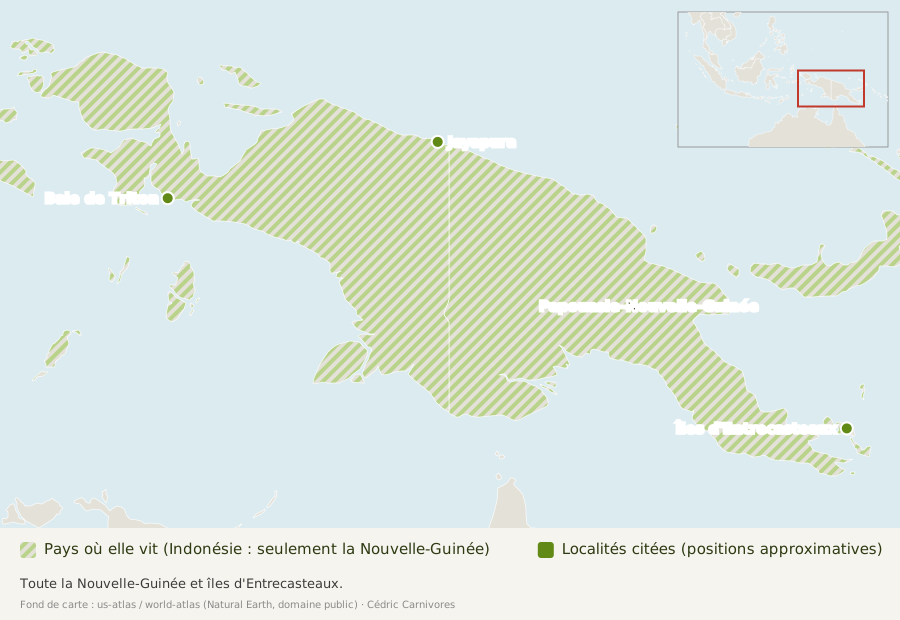
All of New Guinea, in Papua New Guinea as well as in Indonesia, and the D'Entrecasteaux Islands; perhaps also Misool. From sea level to 900 m, sometimes 1,400 m.
Habitat
Riverbanks, gravel bars and ridges; rarely in open grassland or degraded forest.
Natural hybrids
With N. ampullaria and N. maxima, where they grow together; the hybrids are intermediate.
Did you know?
- Danser considered it close to N. tomoriana and N. distillatoria; its foliage looks very much like that of N. papuana.
Sources
- Wikipedia (English), Nepenthes neoguineensis: publication, etymology, history, description, range, altitude, habitat, hybrids, status, relationships.