Nepenthes northiana Hook. f.
Species sheet, updated on 29/10/2026.
At a glance
| Scientific name | Nepenthes northiana Joseph Dalton Hooker, The Gardeners' Chronicle, 1881 |
| Common name | In French “népenthès de Miss North” |
| Synonym | N. decurrens (1925) |
| Family | Nepenthaceae |
| Distribution | Kuching Division, mainly the hills around Bau (Sarawak) |
| Habitat | Seeping limestone cliffs, from 0 to 500 m |
| Status | Vulnerable (IUCN) |
Photos in the wild
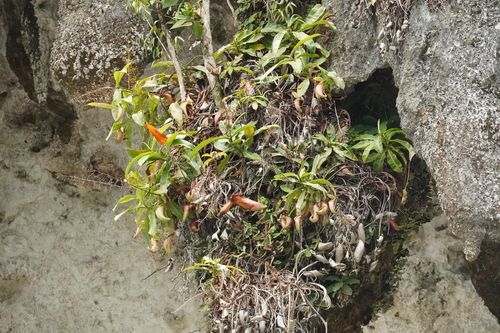
Etymology
- Nepenthes: see the genus sheet.
- northiana: in honour of Marianne North, the English botanical painter who was the first to depict it.
History of the discovery
- 1876: the reference specimen was collected near Jambusan, in Sarawak (Kew).
- Marianne North painted plants sent to her from Bau. Harry Veitch, of the famous Veitch & Sons nursery, recognised an unknown species and sent the plant hunter Charles Curtis to collect its seeds.
- 1881: Hooker described it.
- 1882: Burbidge suggested that it was a hybrid of N. sanguinea and N. veitchii, an idea since rejected: N. sanguinea does not grow on Borneo.
- Its discovery helped build the reputation of Sarawak as a land of spectacular exotic plants.
Description (how to recognise it)
- A climber up to 10 m.
- Huge pitchers: the lower pitchers reach 40 cm tall and 15 cm wide, among the largest in the genus, and sometimes hold nearly a litre.
- Colours: greenish white covered with red spots.
- Peristome: white to red, striped with dark lines, greatly widened at the sides, often with wavy edges.
Distribution
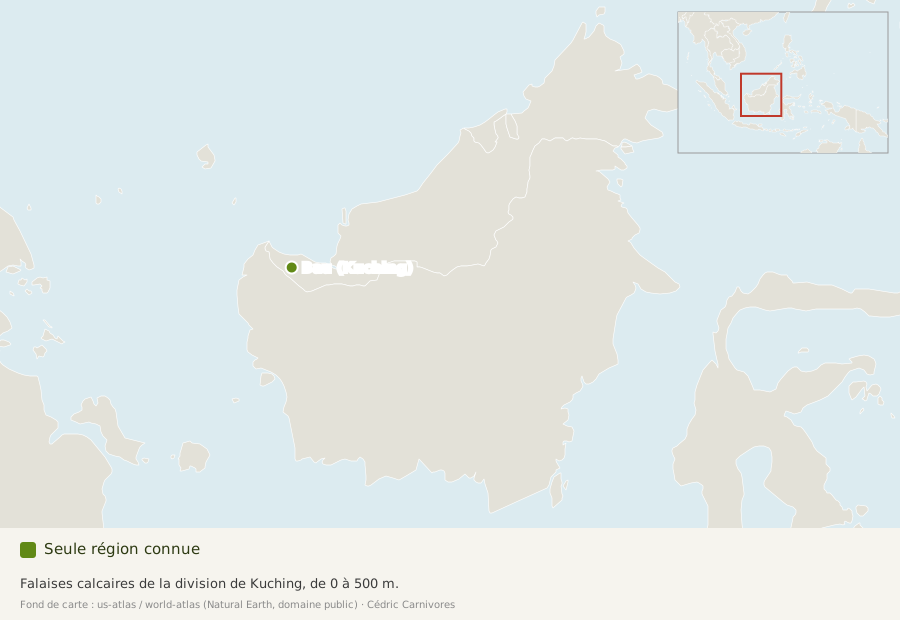
Endemic to the Kuching Division (Sarawak), mainly the hills around Bau, from 0 to 500 m.
Habitat
- Only on limestone;
- usually on almost vertical, exposed cliffs, where water seeps constantly; more rarely in the secondary vegetation of small hills.
Natural hybrids
| Hybrid | Other parent |
|---|---|
| N. × cincta (rare) | N. albomarginata |
| N. × bauensis (a single site) | N. gracilis |
| unnamed (found in 2007) | N. mirabilis |
Threats and protection
- “Vulnerable” according to the IUCN.
- Collected almost to extinction, according to a 1996 monograph. Most of the remaining plants grow on cliffs out of reach.
Sources
- Wikipedia (English), Nepenthes northiana: Hooker 1881, Marianne North, Veitch and Curtis, 1876 specimen, Burbidge's hypothesis, description, range, altitude, limestone habitat, hybrids, status, overcollection.