Nepenthes ovata Nerz & Wistuba
Species sheet, updated on 29/10/2026.
At a glance
| Scientific name | Nepenthes ovata Joachim Nerz & Andreas Wistuba, 1994 |
| Family | Nepenthaceae |
| Distribution | Mountains around Lake Toba, North Sumatra |
| Habitat | Stunted mossy forest and ridges, often among sphagnum, from 1,700 to 2,100 m |
| Status | Least concern (IUCN) |
Etymology
- Nepenthes: see the genus sheet.
- ovata: from the Latin ovatus, “egg-shaped”, for its lower pitchers.
History of the description
- Around 1840-1841: the explorer Franz Wilhelm Junghuhn made the first collection on Mount Lubukraya.
- For a century and a half, it was confused with N. bongso and N. densiflora.
- March 1989: Joachim Nerz collected the reference specimen on Mount Pangulubao, at about 1,800 m. Description in 1994.
Description (how to recognise it)
- A climber up to 5 m.
- Lower pitchers: up to 25 cm by 9, green to red, with a dark red peristome.
- Upper pitchers: yellowish green, up to 20 cm, with an often striped peristome.
- A hook under the lid: a hook-shaped glandular appendage, which sets it apart from its close relatives.
Distribution
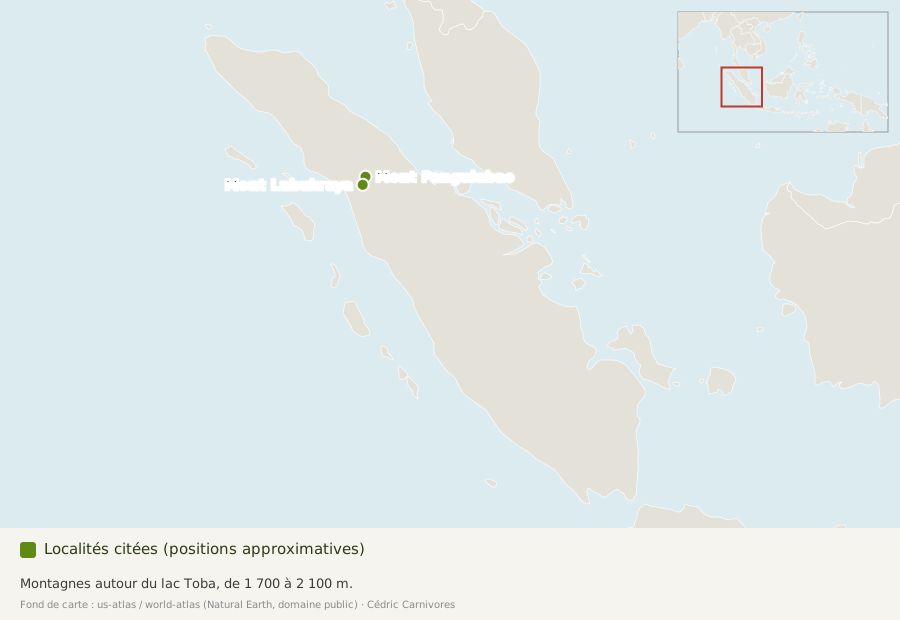
Endemic to Sumatra: mainly the mountains of North Sumatra around Lake Toba, in particular Pangulubao, Lubukraya and Simanukmanuk. From 1,700 to 2,100 m.
Habitat
- Stunted mossy forest and ridge vegetation, often among sphagnum;
- on the ground on the Pangulubao, often on trees on the Lubukraya.
Natural hybrids
At least five, four of them on the Pangulubao: in particular with N. spectabilis, N. mikei, N. rhombicaulis and N. flava (full list, not confirmed).
Threats and protection
“Least concern” according to the IUCN.
Sources
- Wikipedia (English), Nepenthes ovata: Nerz & Wistuba 1994, Junghuhn, 1989 specimen, etymology, description, lid hook, range, altitude, habitat, hybrids, status.
- Wikipedia (English), Nepenthes flava: hybrid with N. ovata.