Nepenthes palawanensis S. McPherson et al.
Species sheet, updated on 29/10/2026.
At a glance
| Scientific name | Nepenthes palawanensis S. McPherson, Cervancia, Chi. C. Lee, Jaunzems, Mey & A. S. Rob., 2010 |
| Family | Nepenthaceae |
| Distribution | Sultan Peak, Palawan Island (Philippines) |
| Habitat | From 1,100 to 1,236 m |
| Status | Endangered (IUCN, 2014) |
Etymology
- Nepenthes: see the genus sheet.
- palawanensis: “from Palawan”, the island where it lives.
History of the discovery
- February 2010: Jehson Cervancia and Stewart McPherson discovered it on Sultan Peak.
- 2010: it was described by six authors: Stewart McPherson, Jehson Cervancia, Ch'ien Lee, Mark Jaunzems, François Mey and Alastair Robinson.
Description (how to recognise it)
- Very large pitchers: sometimes more than 35 cm tall, holding 1.5 to 2 litres of water.
- Orange to red hairs line the inside of the pitcher.
Distribution
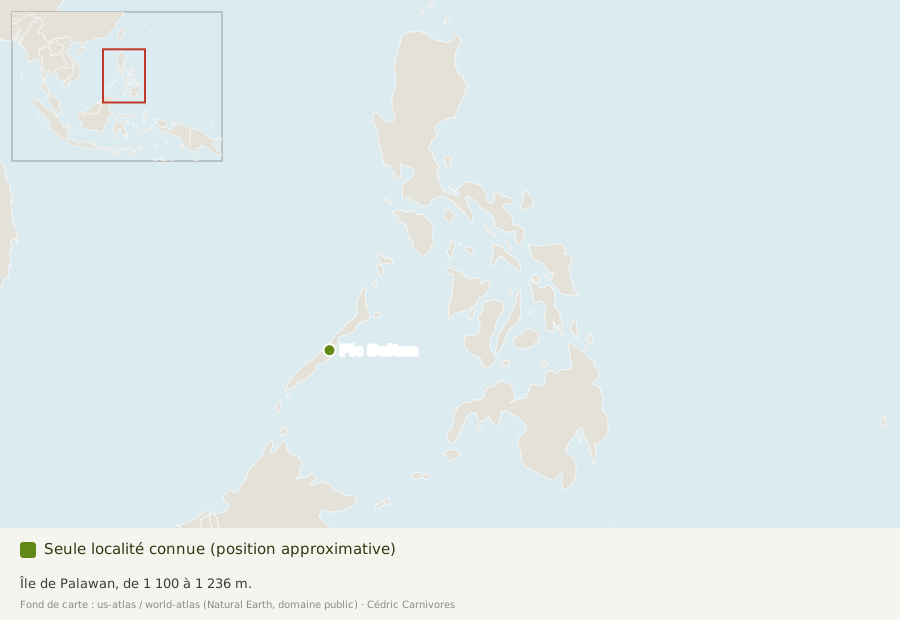
Endemic to Sultan Peak, on Palawan Island (Philippines), from 1,100 to 1,236 m.
Relationships
Its closest relative is N. attenboroughii, from nearby Mount Victoria. N. palawanensis has larger pitchers and orange to red inner hairs, which N. attenboroughii lacks.
Natural hybrids
With a plant that looks like N. philippinensis.
Threats and protection
- “Endangered” according to the IUCN (Clarke and Lee, 2014).
- Neither Sultan Peak nor Mount Victoria is protected. The discovery of N. attenboroughii helped rally local people to protect Mount Victoria; the same effect is hoped for the Sultan range.
Did you know?
- It came 4th in naturalist Chris Packham's ranking of the ten best discoveries of the decade, broadcast by the BBC on 14 December 2010.
Sources
- Wikipedia (English), Nepenthes palawanensis: 2010 authors, February 2010 discovery, pitchers, range, altitude, relationships, hybrid, status, protection, BBC ranking.