Nepenthes papuana Danser
Species sheet, updated on 30/10/2026.
At a glance
| Scientific name | Nepenthes papuana B. H. Danser, Bulletin du Jardin botanique de Buitenzorg, 1928 |
| Family | Nepenthaceae |
| Distribution | Northern and southern slopes of the central mountains of Papua (Indonesian New Guinea) |
| Habitat | Sunny forest edges, from sea level to 1,300 m |
| Status | Least concern (IUCN, 2014) |
Etymology
- Nepenthes: see the genus sheet.
- papuana: from Papua, another name for New Guinea.
History of the description
- 7 October 1909: Lucien von Römer collected it on a hill in the North River (Noordrivier) area, below 750 m.
- 1913: collected by Kloss during the Wollaston expedition, at 920 m.
- 1916: Ridley mistook it for a male N. neoguineensis.
- 1928: Danser described it as a species.
Description (how to recognise it)
- A climber with a stem 5 to 7 mm thick; leaves up to 30 cm by 5.
- Lower pitchers up to 7 cm by 2.5, usually reddish with red spots inside.
- Upper pitchers up to 15 cm by 3, usually green, sometimes reddish.
- Flowers in a simple raceme, almost all borne singly on their pedicel.
Distribution
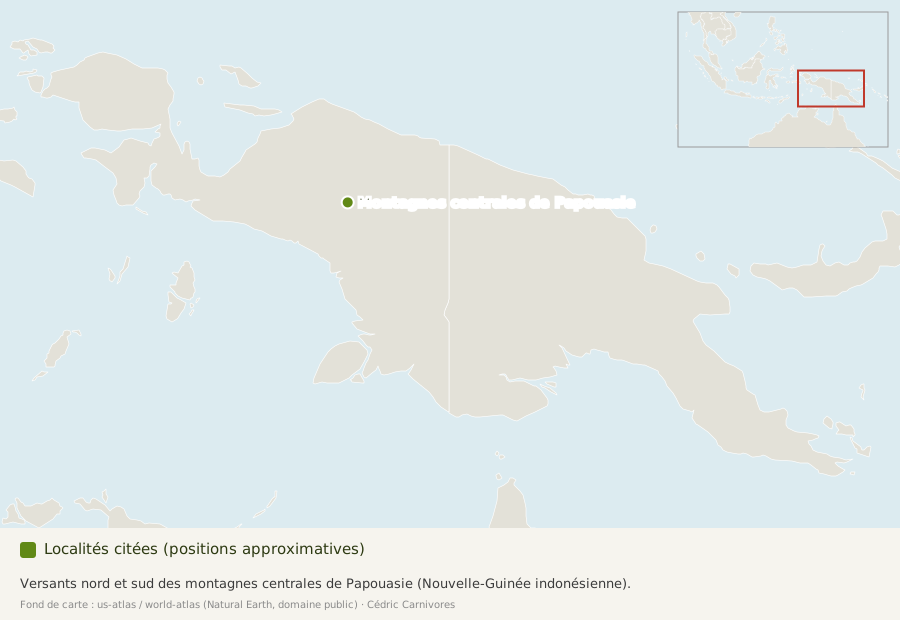
Endemic to New Guinea: northern and southern slopes of the central mountains of Papua province, from sea level to about 1,300 m.
Habitat
Sunny forest edges; its lower pitchers often form in moss.
Ecology
It grows with N. ampullaria, N. insignis, N. maxima and N. mirabilis.
Natural hybrids
With N. paniculata.
Did you know?
- Its closest relative is N. neoguineensis, which has its flowers in a panicle rather than a simple raceme.
Sources
- Wikipedia (English), Nepenthes papuana: publication, synonym, etymology, collections, description, range, altitude, habitat, neighbouring species, hybrid, status, relationships.