Nepenthes parvula Gary W. Wilson & S. Venter
Species sheet, updated on 30/10/2026.
At a glance
| Scientific name | Nepenthes parvula Gary W. Wilson & Stephanus Venter, Phytotaxa 277, 2016 |
| Family | Nepenthaceae |
| Distribution | Cape York Peninsula, Queensland (Australia) |
| Status | Least concern (IUCN, 2020) |
Etymology
- Nepenthes: see the genus sheet.
- parvula: from the Latin, “very small”, for the small size of the adult plants.
Description (how to recognise it)
- Small adult plants.
- A small upright subshrub 35 to 50 cm tall (hence its name, “very small”); stem covered with simple white hairs and dark star-shaped hairs; leathery linear-lanceolate leaves 1 to 2.5 cm wide at the base.
- Close to N. tenax, from which it differs in its small aerial pitchers 3.5 to 6 cm long, with a lid that is red on top and richer in nectar glands, and in its always waterlogged habitat; it is sensitive to cold (it declines below 10 to 12 °C at night).
Distribution
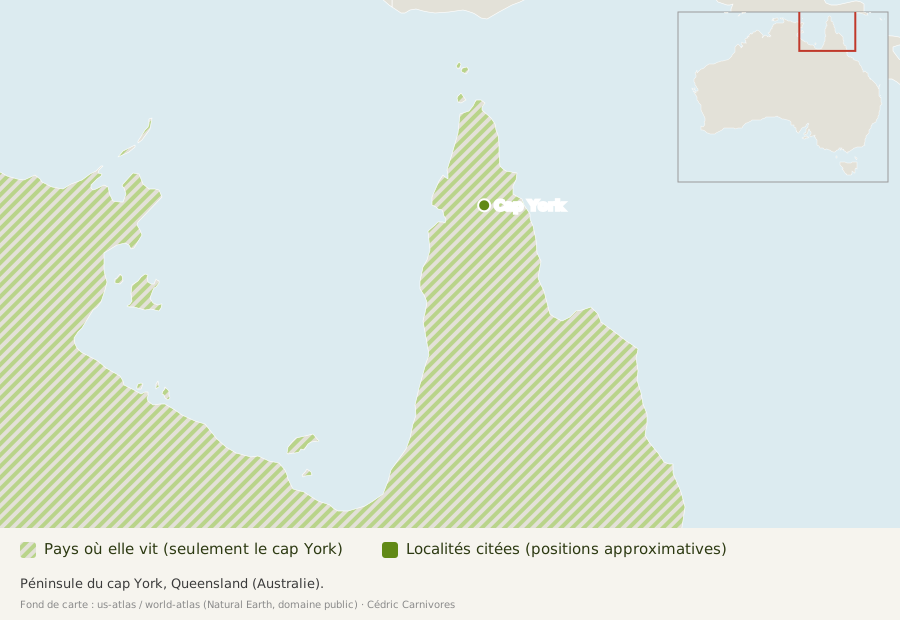
Endemic to Australia: Cape York Peninsula (Queensland).
Habitat
Only in the freshwater swamps of the lower Jardine River basin (Cape York Peninsula, Queensland), from 0 to 30 m, a habitat that does not burn during bush fires; more than 5,000 plants on less than 5 km². Threatened by illegal collecting (plants and seeds) and feral pigs.
Did you know?
- It is the fourth Nepenthes in Australia and the third endemic one, with N. rowaniae and N. tenax; N. mirabilis also grows there.
Sources
- Wikipedia (English), Nepenthes parvula: publication, etymology, range, status, Australian species.
- “Nepenthes parvula (Nepenthaceae), a new species from Cape York, Queensland, Australia” (Plazi text, public domain, via GBIF): original description, habitat, conservation.
- GBIF, Nepenthes parvula: author, original publication, countries and localities of herbarium specimens and observations.