Nepenthes peltata Sh. Kurata
Species sheet, updated on 29/10/2026.
At a glance
| Scientific name | Nepenthes peltata Shigeo Kurata, Journal of Insectivorous Plant Society, 2008 |
| Family | Nepenthaceae |
| Distribution | Mount Hamiguitan, Mindanao (Philippines) |
| Habitat | Mossy forest, ridges, cliffs and landslides on ultramafic rock, from 865 to 1,635 m |
| Status | Not evaluated by the IUCN; considered not threatened by McPherson (2009) |
Etymology
- Nepenthes: see the genus sheet.
- peltata: from the Latin peltatus, “shield-shaped”, for the tendril attached under the leaf rather than at its tip.
History of the description
The Japanese botanist Shigeo Kurata described it in 2008. The reference specimen (Koshikawa 44) comes from the Mount Hamiguitan range; it was grown at the Nanso botanical gardens and then deposited in the Kyoto University herbarium.
Description (how to recognise it)
- A bushy plant, about 1 m tall (stems up to 3 m), which does not climb.
- Leaves: up to 50 cm by 9, dark green above, often dark red below.
- The “shield” tendril: it arises from the underside of the leaf, up to 2.7 cm before the tip, as in N. rajah from Borneo.
- Lower pitchers: very variable in shape, up to 28 cm tall and 16 cm wide, with a peristome up to 2 cm wide.
- Upper pitchers: never observed.
- Long brown hairs on the stems, tendrils and undersides of the leaves.
Distribution
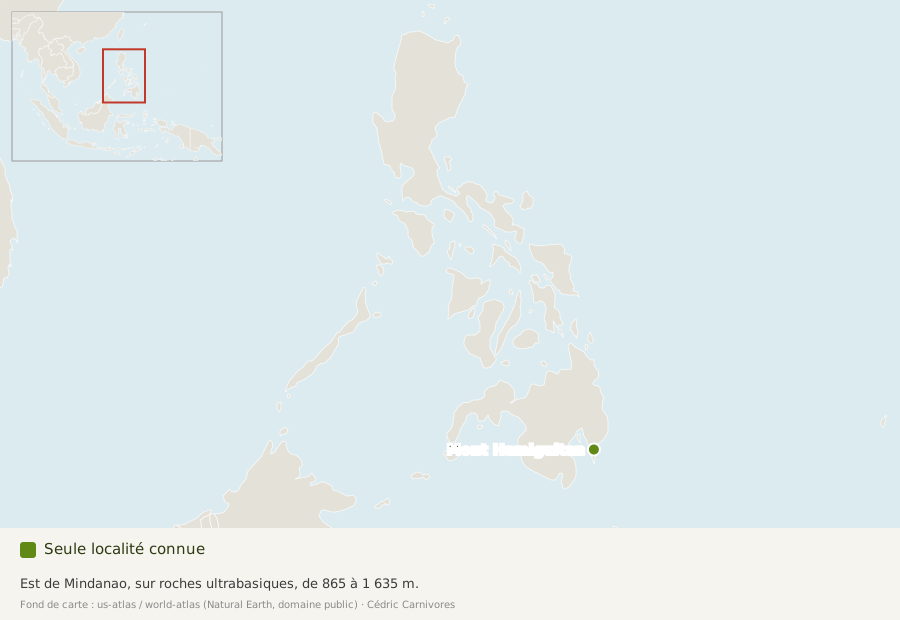
Known only from Mount Hamiguitan, in eastern Mindanao (Philippines), from 865 m to the summit (1,635 m). The surrounding area is little explored: other sites in southern Mindanao are possible.
Habitat
- On the ground, in high-mountain mossy forest, secondary vegetation, on ridges, cliffs and landslides; the vegetation is stunted in exposed places;
- tolerates shade but grows better in full sun;
- only on ultramafic rock (serpentine).
Ecology
It shares Mount Hamiguitan with N. alata (in the broad sense), N. justinae (formerly N. mindanaoensis), N. micramphora and N. hamiguitanensis.
Relationships
It belongs to the N. villosa complex of the ultramafic soils of northern Borneo and Palawan. Its closest relatives are species from Palawan: N. attenboroughii, N. deaniana, N. mantalingajanensis and N. mira.
Natural hybrids
None confirmed. Crosses with N. hamiguitanensis, N. justinae or N. micramphora are possible. The plants once thought to be N. micramphora × N. peltata are now assigned to N. hamiguitanensis, which may itself be of hybrid origin.
Threats and protection
- No IUCN status. Stewart McPherson (2009) considered it not threatened: the populations are extensive and the mountain can only be visited with a guide.
- Mount Hamiguitan was proposed as a UNESCO World Heritage Site (since inscribed in 2014, not confirmed).
Sources
- Wikipedia (English), Nepenthes peltata: Kurata 2008, specimen, etymology, description, range, altitude, ultramafic habitat, neighbouring species, relationships, hybrids, protection (McPherson 2009).