Nepenthes philippinensis Macfarl.
Species sheet, updated on 30/10/2026.
At a glance
| Scientific name | Nepenthes philippinensis John Muirhead Macfarlane, 1908 |
| Synonyms | N. wilkiei |
| Family | Nepenthaceae |
| Distribution | Palawan, Calamian Islands and Linapacan (Philippines) |
| Habitat | From sea level to 600 m |
| Status | Least concern (IUCN) |
Etymology
- Nepenthes: see the genus sheet.
- philippinensis: “from the Philippines”.
Description (how to recognise it)
- A record in the genus: it is the species that bears the most inflorescences at once, up to 190 on a single plant.
- According to Macfarlane (1908), who described it: a robust climber, with a stem 6 to 10 m long; leathery, lanceolate leaves without a petiole, 15 to 25 cm by 2.5 to 5 cm; tendril 15 to 20 cm.
- Pitchers 8 to 12 cm by 2 to 3.5 cm; the lower ones tubular and swollen, with wings 4 to 5 mm wide fringed with long hairs; the upper ones tubular, with narrow wings; green or reddish green below, usually red above, covered with reddish-brown hairs when young; cylindrical peristome 6 to 7 mm; lid reddish green or red. Male racemes 45 to 55 cm long, with flowers usually in pairs.
Distribution
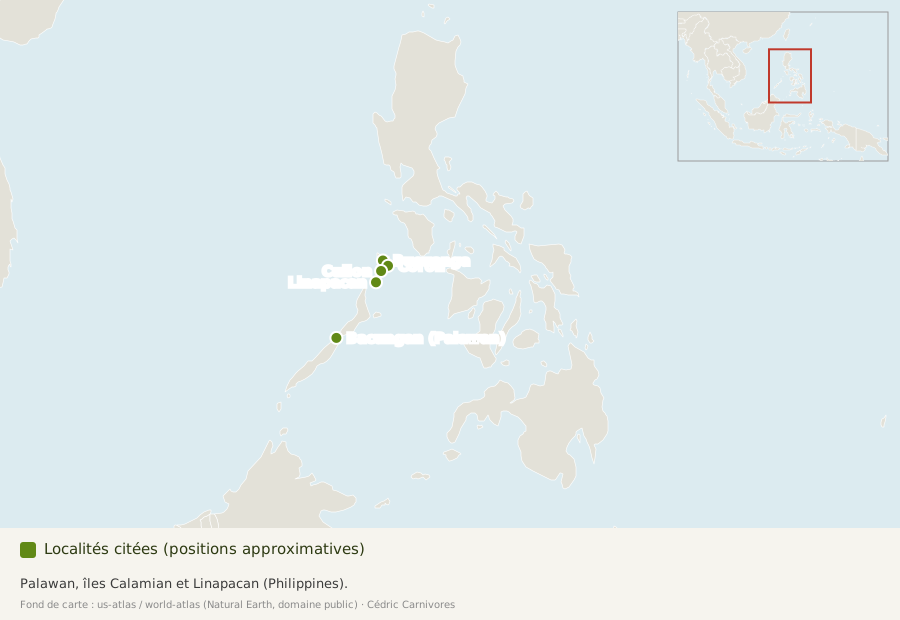
Endemic to the Philippines: Palawan (type site at Bacungan), the Calamian Islands (Busuanga, Coron, Culion) and Linapacan, from sea level to 600 m.
Habitat
Macfarlane (1908) cites Foxworthy's type specimen, collected on Mount Victoria (Palawan) at about 350 m, and a collection from Mount Pulgar (Palawan) at about 1,300 m.
Natural hybrids
None known.
Did you know?
- According to Jebb and Cheek, it is closer to the Bornean species N. hirsuta, N. hispida and N. macrovulgaris than to N. alata.
Sources
- Wikipedia (English), Nepenthes philippinensis: author, synonym, inflorescences, range, altitude, status, relationships.
- Macfarlane, Das Pflanzenreich IV.111: Nepenthaceae, 1908 (archive.org): description, localities and altitudes of the specimens (translated from Latin and German).
- GBIF, Nepenthes philippinensis: author, original publication, countries and localities of herbarium specimens and observations.