Nepenthes pilosa Danser
Species sheet, updated on 29/10/2026.
At a glance
| Scientific name | Nepenthes pilosa B. H. Danser, 1928 |
| Common name | In French “népenthès à fourrure dorée” (Phillipps and Lamb) |
| Family | Nepenthaceae |
| Distribution | Bukit Batu Lesung range, East Kalimantan (Borneo) |
| Habitat | Mossy forest, at about 1,600-1,700 m |
| Status | Data deficient (IUCN, 2014) |
Etymology
- Nepenthes: see the genus sheet.
- pilosa: from the Latin pilosus, “hairy”.
History of the discovery
- 1899: the Javanese collector Amdjah collected it during the Nieuwenhuis expedition to central Borneo.
- 1928: Danser described it.
- For a long time, it was confused with N. chaniana.
- 2004: Charles Clarke found it again at its original locality: the first collection since 1899. He revisited the populations in 2006.
Description (how to recognise it)
- A climber more than 7 m long.
- Lower pitchers: about 10 cm; upper pitchers: about 18 cm.
- Entirely covered with yellowish-brown hairs, like a golden fur coat.
- Hooked lid: a hook-shaped ridge near the base, a rare feature. On Borneo, only N. burbidgeae and N. chaniana have a similar appendage.
Distribution
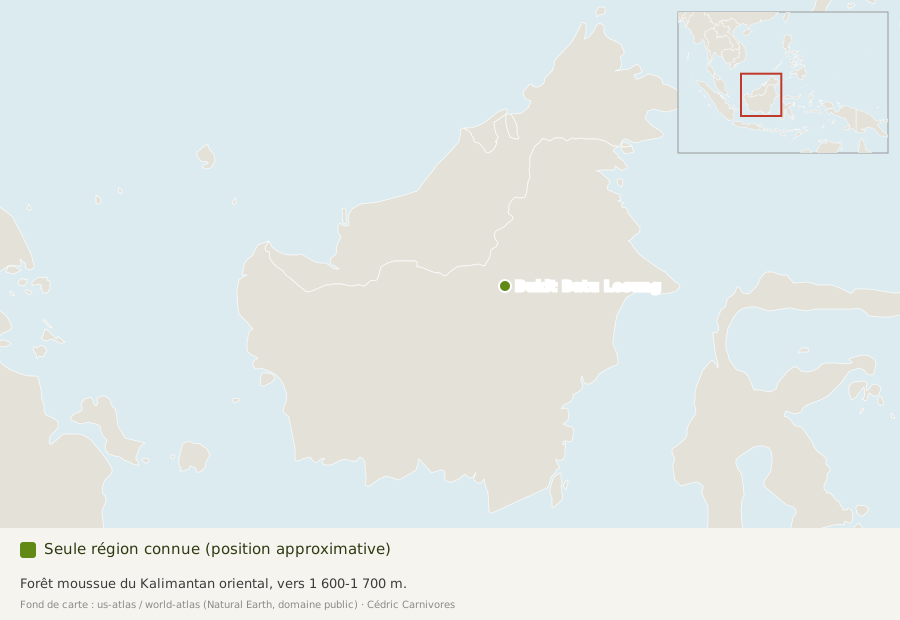
Endemic to the Bukit Batu Lesung range, in East Kalimantan, at about 1,600 to 1,700 m. One known population numbers about 200 plants.
Habitat
Mossy forest.
Relationships
maxima complex; close to N. chaniana from Sabah and Sarawak, which has more cylindrical pitchers.
Natural hybrids
None known.
Threats and protection
“Data deficient” according to the IUCN (2014).
Sources
- Wikipedia (English), Nepenthes pilosa: Danser 1928, Amdjah 1899, Nieuwenhuis expedition, 2004 rediscovery, etymology, description, hooked lid, range, altitude, population, habitat, status.