Nepenthes pitopangii Chi. C. Lee, S. McPherson, Bourke & M. Mansur
Species sheet, updated on 30/10/2026.
At a glance
| Scientific name | Nepenthes pitopangii Ch'ien Lee, Stewart McPherson, Greg Bourke & M. Mansur, The Gardens' Bulletin Singapore 61, 2009 |
| Family | Nepenthaceae |
| Distribution | Central and northern Sulawesi: two sites (Indonesia) |
| Habitat | Secondary or mossy montane forest, from 1,400 to 1,800 m |
| Status | Vulnerable (IUCN) |
Etymology
- Nepenthes: see the genus sheet.
- pitopangii: in honour of Rahmadanil Pitopang, curator of the Celebense herbarium, who collected the type specimen.
History of the description
- September 2006: the British veterinarian Jonathan Newman discovered it in Lore Lindu National Park.
- 30 May 2007: collection of the type specimen.
- March 2011: a second population of about a dozen plants was found more than 100 km away.
Description (how to recognise it)
- Dark red to purple stems.
- Lower pitchers about 6 cm, mostly red spotted with yellowish.
- Upper pitchers smaller, about 4.5 cm, swollen just below the mouth, with no teeth on the peristome; lid almost round.
Distribution
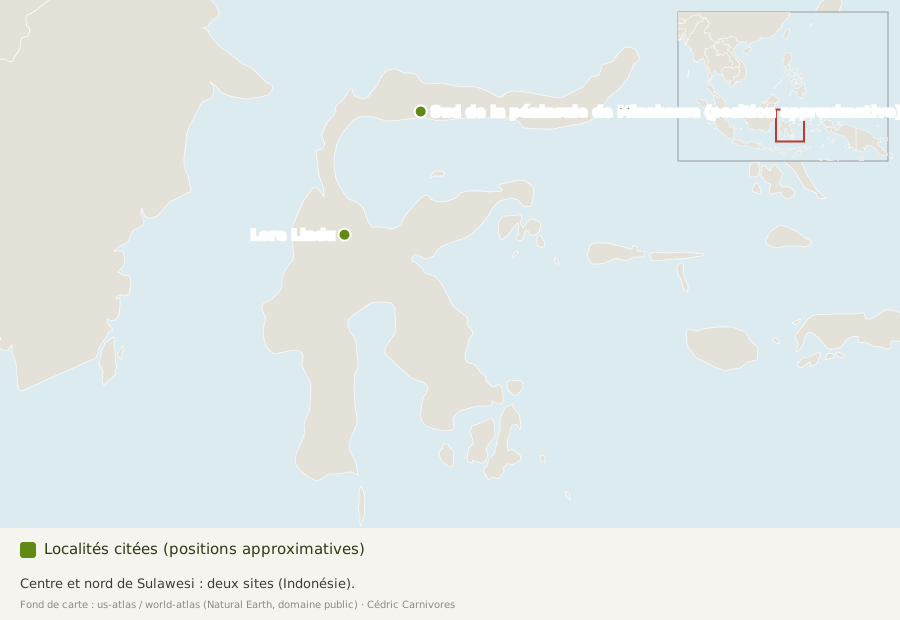
Endemic to Sulawesi: a single large plant at the type site, in Lore Lindu National Park (centre), at about 1,800 m; about a dozen plants at about 1,400 m on a ridge in the south of the Minahassa Peninsula.
Habitat
- At the type site: shady secondary forest at lower montane level.
- At the second site: exposed mossy forest, on the ground and on trees.
Natural hybrids
A suspected cross with N. tentaculata at the second site.
Did you know?
- Its closest relative is N. glabrata, whose upper pitchers are more elongated and well winged.
Sources
- Wikipedia (English), Nepenthes pitopangii: publication, etymology, discovery, description, sites, altitude, habitat, hybrid, status, relationships.