Nepenthes pongoides Damit, Yusof, Jumian & A. S. Rob.
Species sheet, updated on 30/10/2026.
At a glance
| Scientific name | Nepenthes pongoides Damit, Yusof, Jumian & Alastair Robinson, Australian Journal of Botany 72, 2024 |
| Family | Nepenthaceae |
| Distribution | Meliau Range, central Sabah (Borneo) |
| Habitat | From about 900 m upwards |
| Status | Critically endangered |
Etymology
- Nepenthes: see the genus sheet.
- pongoides: from the genus Pongo, the orangutans, and the Greek -oides, “resembling”: for the long reddish-brown hairs that cover the stems, leaves, tendrils and pitchers.
Description (how to recognise it)
- One of the largest Nepenthes described in recent years.
- Long, coarse, dark red hairs, unmatched among the other Nepenthes of Borneo.
- Tendril attached beneath the leaf; no upper pitchers known.
- No flowering plant has been seen yet.
- According to its description (2024): one of the largest Nepenthes described in recent years; tendril attached beneath the leaf blade (peltate leaf), no upper pitchers, and a persistent covering of long, stiff, dark red hairs, more developed than in any other Nepenthes of Borneo (hence its name, which recalls the orangutan).
Distribution
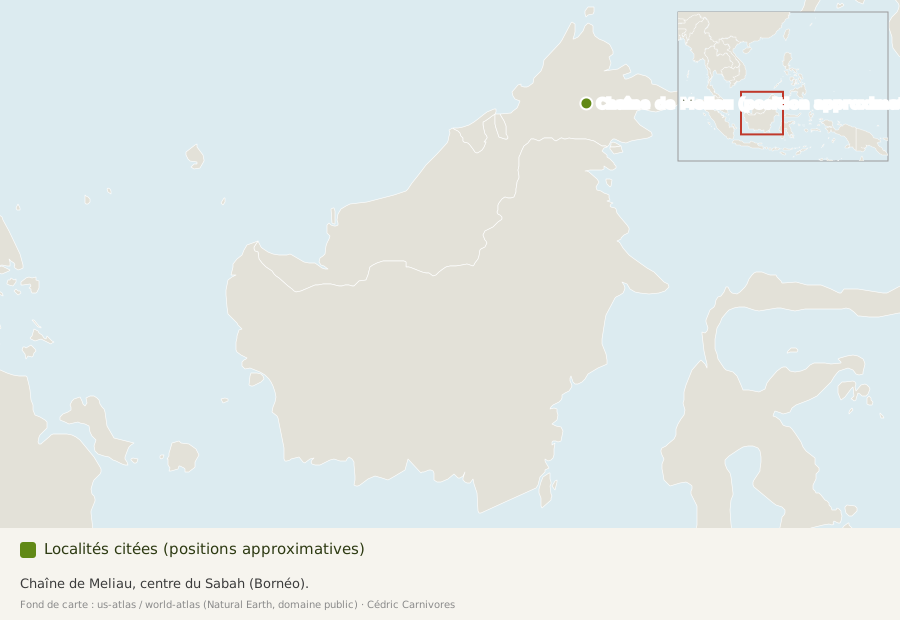
Micro-endemic to Borneo: Meliau Range, in central Sabah, from about 900 m upwards.
Habitat
Micro-endemic to the Meliau Range (central Sabah), a rarely visited low-altitude ultramafic summit; only 39 adult plants in two subpopulations: “critically endangered”, threatened by poaching for horticulture and by fires.
Sources
- Wikipedia (English), Nepenthes pongoides: publication, etymology, description, range, altitude, status.
- “Sabah's hidden giant: Nepenthes pongoides”, Australian Journal of Botany, 2024 (open licence): abstract of the article.