Nepenthes rafflesiana Jack
Species sheet, updated on 29/10/2026.
At a glance
| Scientific name | Nepenthes rafflesiana William Jack, 1835 |
| Common name | In French “Népenthès de Raffles” |
| Synonyms | N. nigropurpurea, N. sanderiana… |
| Family | Nepenthaceae |
| Distribution | Borneo, Sumatra (west coast), Peninsular Malaysia, Singapore and small islands |
| Habitat | Open, sandy, damp places, from sea level to 1,200 m (perhaps 1,500 m) |
| Status | Least concern (IUCN, 2018); CITES Appendix II |
Photos in the wild
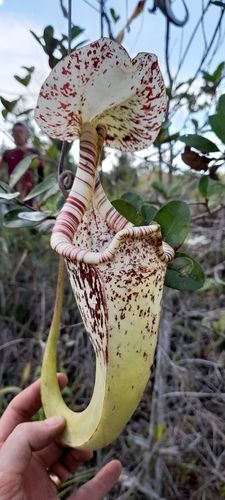
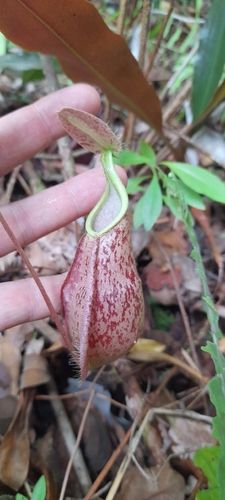
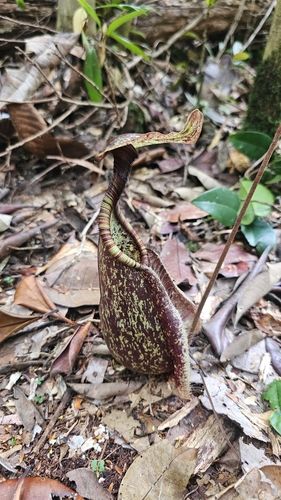
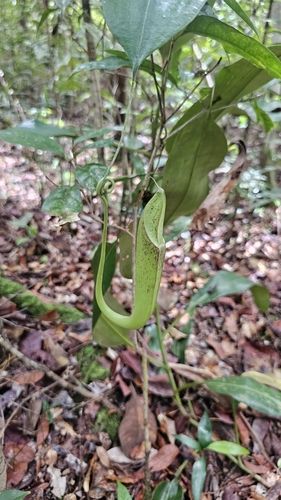
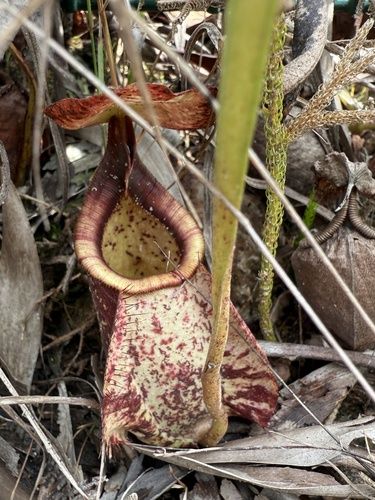
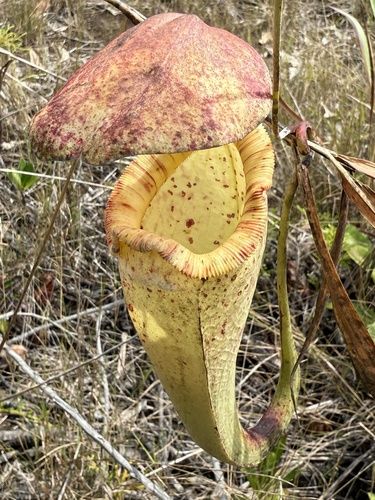
Etymology
- Nepenthes: see the genus sheet.
- rafflesiana: in honour of Sir Stamford Raffles, founder of Singapore.
History of the discovery
- 1819: the Scottish physician William Jack found it near Singapore. He described it in a letter published later in Curtis's Botanical Magazine (1835).
- In 1850, it was presented as the largest species of the genus known at the time.
Description (how to recognise it)
- A climber that can reach 15 m, with tendrils sometimes over 1.10 m long.
- Lower pitchers: swollen, with wings, rarely more than 20 cm.
- Upper pitchers: funnel-shaped.
- Colours: from dark purple to almost white. The typical form has light green lower pitchers spotted with purple and cream upper pitchers.
- Like all Nepenthes, each plant is male or female.
The giant form
In a few isolated sites in north-western Borneo, notably near Sematan, about 110 km west of Kuching, a giant form grows:
- lower pitchers about 35 cm by 15, sometimes holding more than a litre;
- leaves 2.5 times longer; inflorescences over a metre long;
- young leaves with a bronze sheen.
It keeps these features in cultivation: so it is not just an effect of its environment.
Distribution
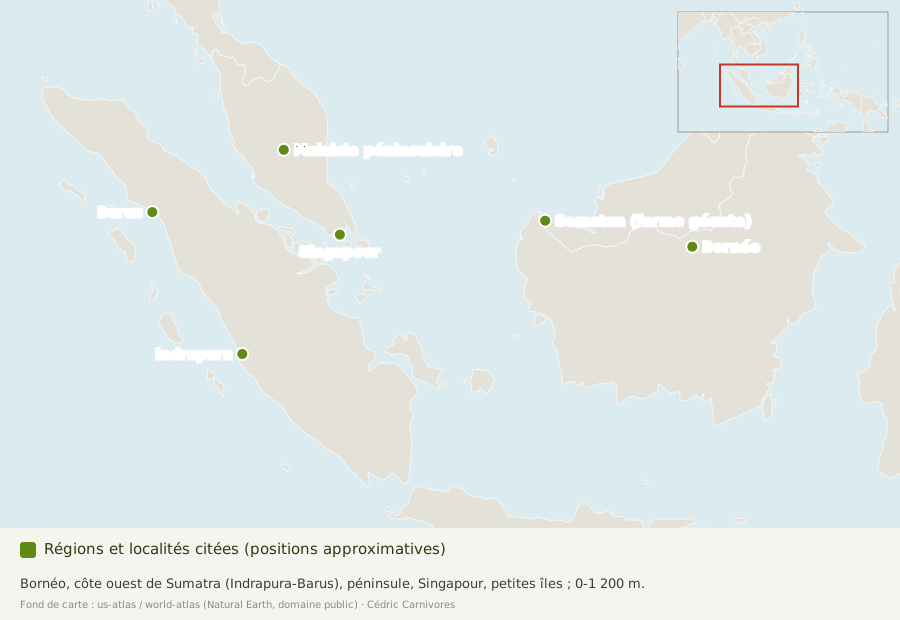
- Borneo, where it is common;
- Sumatra: only the west coast, from Indrapura to Barus;
- Peninsular Malaysia and Singapore;
- the Riau, Bangka, Labuan, Natuna and Lingga islands.
Habitat
Open, sandy, damp places: kerangas forest, edges of peat swamps, wooded heathland, seaside cliffs.
Varieties
Most of the varieties described are no longer recognised: var. insignis (large, strongly marked pitchers), alata, ambigua, glaberrima, nivea… The former “elongated form” (var. elongata) is today a separate species: N. hemsleyana.
Natural hybrids
With N. ampullaria (N. × hookeriana), N. gracilis, N. mirabilis, N. bicalcarata, N. albomarginata, N. clipeata, N. hemsleyana and N. benstonei.
Threats and protection
- “Least concern” for the IUCN; trade regulated by CITES Appendix II.
- Like most Nepenthes, it suffers from the destruction of its habitat, and a little from poaching. Most plants sold come from in vitro culture or cuttings.
Sources
- Wikipedia (English), Nepenthes rafflesiana: Jack 1819/1835, etymology, synonyms, description, giant form, range, altitude, habitat, varieties, hybrids, status, CITES.
- (Raffles “founder of Singapore”: general historical note.)