Nepenthes rajah Hook. f.
Species sheet, updated on 29/10/2026.
At a glance
| Scientific name | Nepenthes rajah Joseph Dalton Hooker, Transactions of the Linnean Society of London 22(4), 1859 |
| Family | Nepenthaceae |
| Common names | In French népenthès rajah; nicknamed the “king of Nepenthes” |
| Distribution | Mount Kinabalu and Mount Tambuyukon, Sabah (Malaysian Borneo) |
| Habitat | Serpentine soils, seepages, from 1,500 to 2,650 m |
| Status | Endangered (IUCN, 2000); CITES Appendix I |
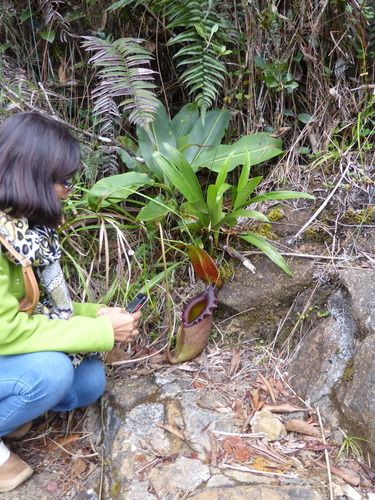
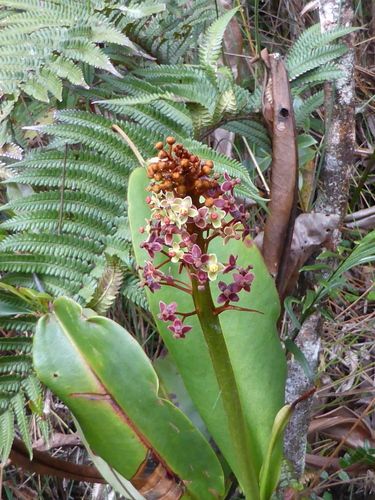
Photos in the wild
Etymology
- Nepenthes: see the genus sheet (a drug in the Odyssey that makes one forget sorrow).
- rajah: in honour of James Brooke, the first “White Rajah” of Sarawak. In Malay, rajah means “king”: hence its nickname “king of Nepenthes”.
History of the discovery
- 1858: Hugh Low, a British colonial administrator and naturalist, collected it on Mount Kinabalu.
- 1859: the great English botanist Joseph Dalton Hooker described it.
Description (how to recognise it)
- Habit: a scrambling climber, with stems up to 6 m, rarely more than 3 m.
- The largest pitchers in the genus: the lower pitchers reach about 41 cm tall and 20 cm wide. They can hold nearly 3.5 litres of water and more than 2.5 litres of digestive fluid, although most hold far less.
- Peristome: a red, scalloped rim with pointed teeth.
- Lid: very large, vaulted, with a central ridge and two marked side veins.
- Upper pitchers: smaller, they appear only on mature plants, and they are rare.
Distribution
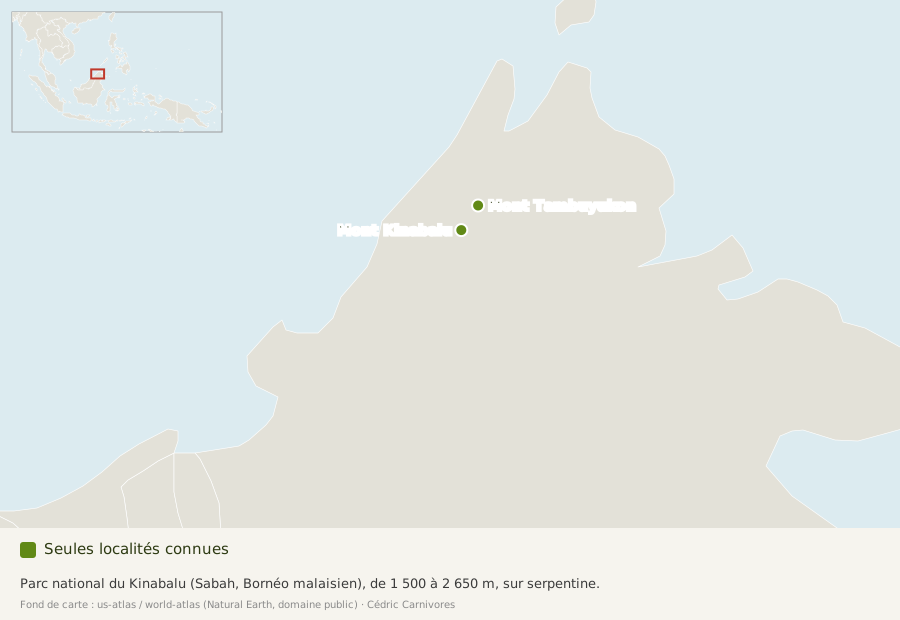
Endemic to Mount Kinabalu and neighbouring Mount Tambuyukon, in Sabah (Malaysian Borneo), within Kinabalu National Park. From 1,500 to 2,650 m altitude.
Habitat
- Only on serpentine soils (ultramafic), rich in nickel and chromium, toxic to most plants;
- usually where groundwater seeps out, which keeps the soil loose and moist.
Ecology
- A toilet for treeshrews: the mountain treeshrew (Tupaia montana), a small mammal, comes to lick the nectar under the lid and defecates into the pitcher. The plant is thought to get much of its nitrogen from these droppings.
- Rats too: the summit rat (Rattus baluensis) does the same, mainly at night.
- Large prey: it can trap small mammals, such as rats, and sometimes frogs, lizards and birds. But most of its prey are insects, mainly ants.
- Its inhabitants: its pitchers shelter a specialised fauna, including two mosquitoes named after it, Culex rajah and Toxorhynchites rajah.
Natural hybrids
It hybridises with all the Nepenthes species that share its range; its pollen is thought to travel up to 10 km.
| Hybrid | Other parent |
|---|---|
| N. × alisaputrana | N. burbidgeae |
| N. × kinabaluensis | N. villosa |
| unnamed | N. edwardsiana, N. fusca, N. lowii, N. macrovulgaris, N. stenophylla, N. tentaculata |
Threats and protection
- Classification: “Endangered” for the IUCN (2000); CITES Appendix I, which bans international trade in wild plants.
- Threats: the populations were plundered by collectors in the 1970s, and are threatened by habitat degradation and by droughts linked to El Niño.
Did you know?
- Its pitchers, the largest in the genus, can hold nearly 3.5 litres.
- Two mosquitoes are named after it.
- It is called the “king of Nepenthes”.
Sources
- Wikipedia (English), Nepenthes rajah: Hooker 1859, Hugh Low 1858, James Brooke, description, measurements, range, altitude, serpentine, treeshrews and rats, prey, mosquitoes, hybrids, statuses, threats; references: Clarke & Wong 1997, Nepenthes of Borneo; Kurata 1976, Nepenthes of Mount Kinabalu; Greenwood et al. 2011, PLoS ONE 6(6).
- List of hybrids: “Genre Nepenthes : liste complète des taxons”.