Nepenthes reinwardtiana Miq.
Species sheet, updated on 29/10/2026.
At a glance
| Scientific name | Nepenthes reinwardtiana Friedrich Anton Wilhelm Miquel, 1852 |
| Common name | In French “Népenthès de Reinwardt” |
| Family | Nepenthaceae |
| Distribution | Borneo and Sumatra, and small neighbouring islands (Bangka, Natuna, Nias, Siberut) |
| Habitat | From sea level to 2,200 m |
| Status | Least concern (IUCN, 2020) |
Photos in the wild
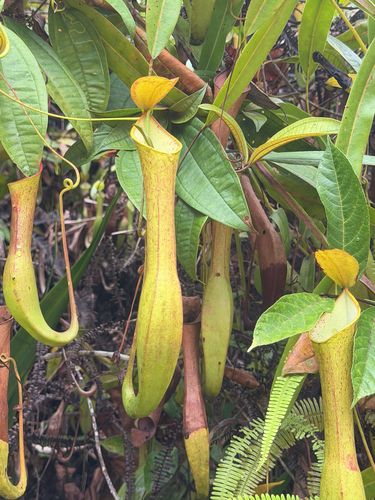
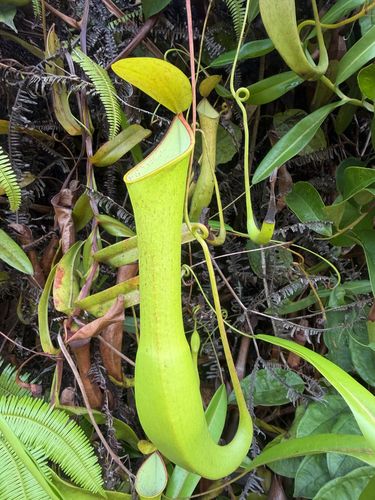
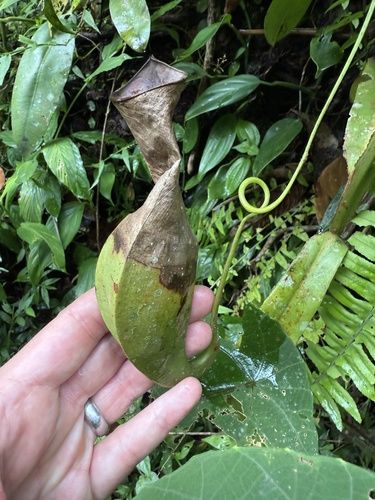
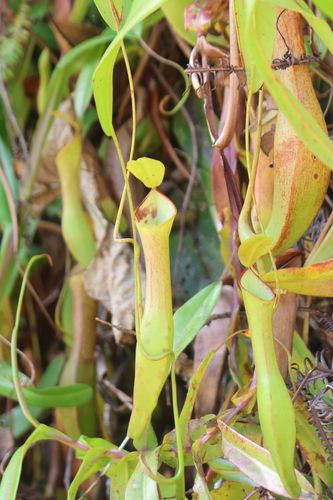
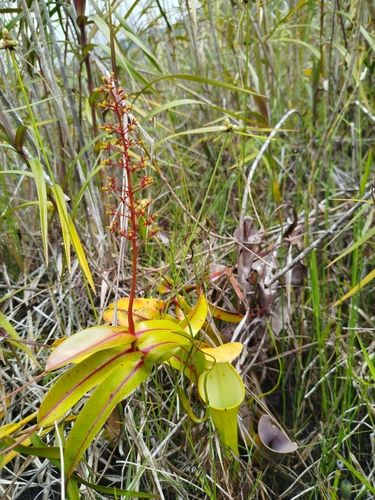
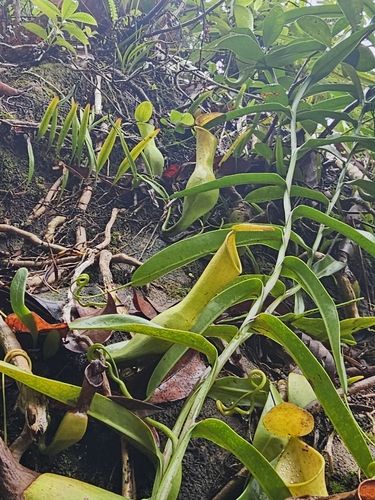
Etymology
- Nepenthes: see the genus sheet.
- reinwardtiana: in honour of the botanist Caspar Georg Carl Reinwardt.
History of the description
The Dutch botanist Miquel described it in 1852. In 1859, Hooker mistakenly wrote it as N. reinwardtii.
Description (how to recognise it)
- Pitchers in every colour, from green to dark red.
- The two “eyes”: inside the pitcher, below the peristome, two clearly visible spots, its most distinctive feature.
Distribution
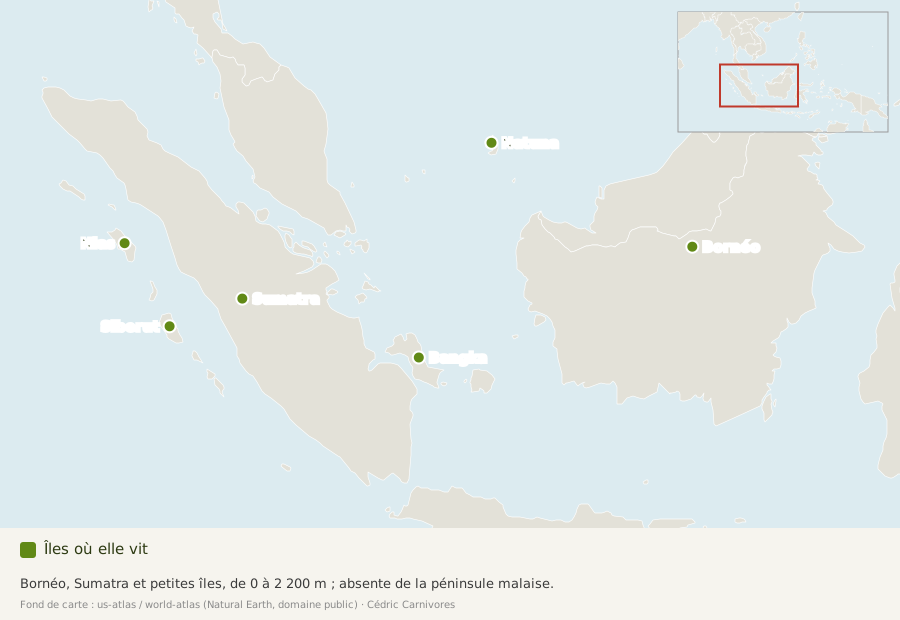
Borneo and Sumatra, plus the islands of Bangka, Natuna, Nias and Siberut. The records from Peninsular Malaysia and Singapore appear to be mistaken.
From sea level to 2,200 m: an unusually wide altitude range, which makes it both a lowland and a mountain plant.
Varieties and related names
- var. samarindaensis (Adam & Wilcock, 1993), from Kalimantan.
- N. naquiyuddinii (Adam & Hafiza, 2006), from Sabah: described as a species, but perhaps just a synonym, or a hybrid with N. fusca.
Relationships
Genetic studies place it next to N. macrovulgaris from Borneo, and not with the species it seemed close to in shape.
Natural hybrids
Very numerous: with N. albomarginata (N. × ferrugineomarginata), N. ampullaria, N. clipeata, N. fusca, N. gracilis, N. gymnamphora, N. hispida, N. macrovulgaris, N. mirabilis, N. spathulata, N. stenophylla, N. tentaculata and N. tobaica.
Threats and protection
“Least concern” for the IUCN (Clarke, 2020).
Sources
- Wikipedia (English), Nepenthes reinwardtiana: Miquel 1852, etymology, synonyms, eye-shaped spots, range, altitude, variety, N. naquiyuddinii, phylogeny, hybrids, status.
- (Position of the “eyes” below the peristome: general knowledge, not confirmed)