Nepenthes rhombicaulis Sh. Kurata
Species sheet, updated on 29/10/2026.
At a glance
| Scientific name | Nepenthes rhombicaulis Shigeo Kurata, 1973 |
| Family | Nepenthaceae |
| Distribution | Around Lake Toba (North Sumatra): Pangulubao massif, Mount Lubukraya |
| Habitat | Understorey of shady montane forest, on steep slopes, from 1,600 to 2,000 m |
| Status | Vulnerable (IUCN) |
Etymology
- Nepenthes: see the genus sheet.
- rhombicaulis: from the Latin “rhombus” and “stem”, for its stem with a diamond-shaped cross-section.
History of the description
Shigeo Kurata collected it in 1972 on Mount Pangulubao, at about 1,700-1,900 m, and described it in 1973. Its upper pitchers were reported in 1993 by Rudolf Schmid-Höllinger, then by Charles Clarke; their identity has been debated.
Description (how to recognise it)
- A giant climber: its stem can reach 35 m, one of the longest in the genus.
- Leaves: up to 25 cm by 4.
- Lower pitchers: up to 12 cm, with a round, oblique mouth, dull green to light red spotted with purple.
- Upper pitchers: yellowish green spotted with pale red, more elongated, with a reduced peristome.
Distribution
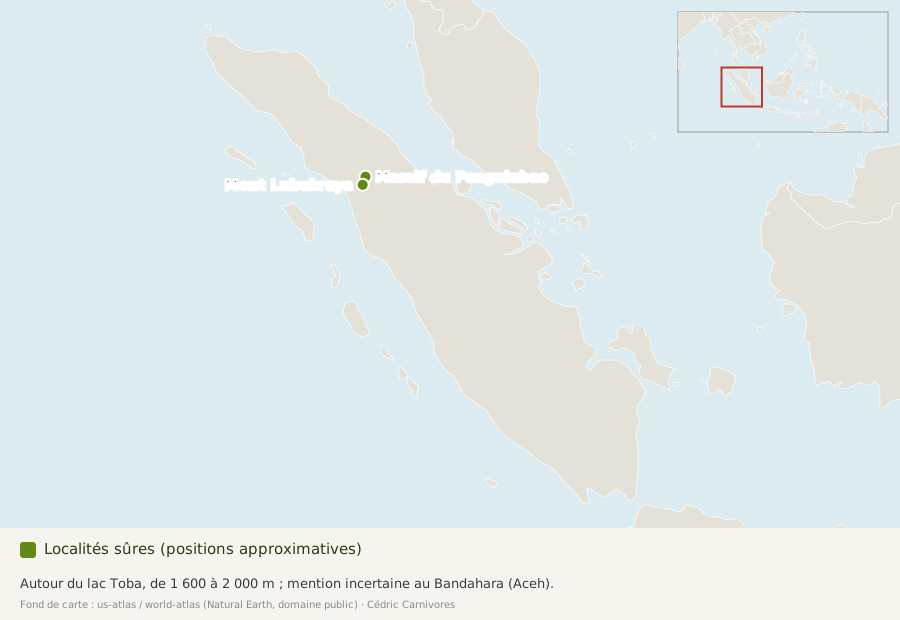
North Sumatra, around Lake Toba: Pangulubao massif and Mount Lubukraya; uncertain records from Mount Bandahara (Aceh). From 1,600 to 2,000 m.
Habitat
Shady montane forest, often on steep slopes. It is one of the few Nepenthes that are common in the understorey.
Ecology
Its lower pitchers often grow half buried in the leaf litter. Bruce Salmon suggested that they trap ground-dwelling insects, an idea that has not been checked.
Natural hybrids
With the species that grow alongside it: N. flava, N. ovata, N. spectabilis and N. tobaica.
Threats and protection
“Vulnerable” for the IUCN, because of its small range.
Sources
- Wikipedia (English), Nepenthes rhombicaulis: Kurata 1972/1973, etymology, upper pitchers, description, range, altitude, habitat, pitchers in the litter, hybrids, status.