Nepenthes robcantleyi Cheek
Species sheet, updated on 29/10/2026.
At a glance
| Scientific name | Nepenthes robcantleyi Martin Cheek, Nordic Journal of Botany, 2011 |
| Nickname | “black truncata” |
| Family | Nepenthaceae |
| Distribution | A single known site, kept secret, on Mindanao (Philippines) |
| Habitat | Submontane evergreen forest, at about 1,800 m |
| Status | “Critically endangered” according to Cheek (informal assessment), perhaps extinct in the wild |
Etymology
- Nepenthes: see the genus sheet.
- robcantleyi: in honour of Robert Cantley, founder of the Borneo Exotics nursery, who discovered it, propagated it and brought it into cultivation. Cheek wrote “robcantleyi” and not “cantleyi”, because the latter name was already in use for a hybrid that was never described.
History of the discovery
- January 1997: Robert Cantley was looking for seeds of N. truncata on an isolated mountain on Mindanao, in a logging concession, accompanied by the company's head of security. Near the top of a small hill, among N. truncata, he found two large unknown plants, one of them with very dark pitchers, in full sun, about 1.5 m across.
- Only a few seeds were left on the plant.
- The area was cleared soon afterwards: two trips in 1998 and 1999 found no plants. The original population is considered lost.
- 2011: Martin Cheek, of the Royal Botanic Gardens, Kew, described it from cultivated plants grown from those seeds.
A species saved by cultivation
- The 1997 seeds produced 11 plants: 4 went to Tony Paroubek (United States), 1 to Shinya Yamada (Japan), and 6 stayed at Borneo Exotics.
- Two of them, 'Queen of Hearts' and 'King of Spades', flowered at the same time and were crossed: their offspring, about 3,000 seedlings, are the source of almost all cultivated plants.
- It has been sold since late 2009 and has featured in Borneo Exotics' gold-medal displays at the Chelsea Flower Show.
Description (how to recognise it)
- A shrub 0.5 to 1 m tall, which does not climb, with stems about 2 cm thick.
- Leaves: thick and leathery, up to 28 cm by 26, heart-shaped at the base.
- Pitchers: up to 33 cm tall, cylindrical, with fringed wings. The peristome is huge, 6 to 10 cm wide at the back, ribbed and toothed.
- Colours: pitchers reddish brown to almost black, glossy, sometimes with green wings; inside bright green spotted with purple.
- No true upper pitchers.
- A record: the male inflorescence reaches 2.13 m, the tallest of all Nepenthes, and perhaps of all carnivorous plants.
Distribution
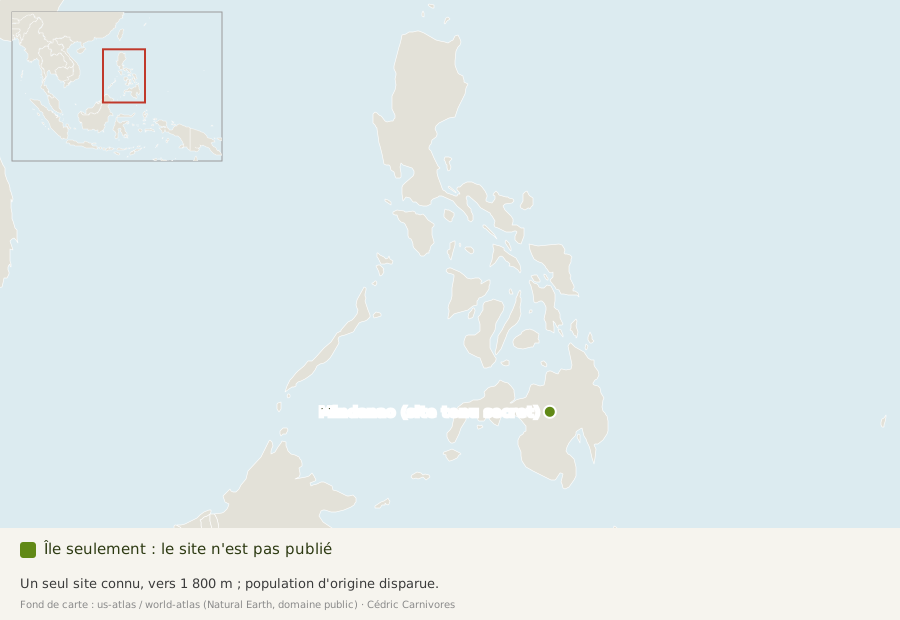
Known with certainty from a single site on Mindanao, whose location is not published in order to protect it. The map therefore only shows the island.
Habitat
In 1997, the plants grew on the ground, at about 1,800 m, in submontane evergreen forest, with a giant form of N. alata. It is probably also epiphytic, like N. truncata.
Possible rediscovery
- 2011: Andy Smith photographed similar epiphytic plants from a distance. He found them again in 2013: they appear identical.
- 2012: Wally Suarez also came across similar plants on Mindanao.
Relationships
- Its closest relative is N. truncata, from which it differs by its fringed wings and its much wider, flatter peristome. The two are the only Philippine species in section Regiae.
- Cheek ruled out a hybrid origin. Later, Mansell and Suarez suggested a hybrid N. truncata × N. nebularum, but crosses made in cultivation do not look like it.
Natural hybrids
None confirmed. One of the plants sent to the United States (“clone C”) was intermediate with N. truncata; it died.
Sources
- Wikipedia (English), Nepenthes robcantleyi: Cheek 2011, 1997 discovery, loss of the site, cultivated plants, description, record inflorescence, habitat, possible rediscoveries, relationships, debated hybrid origin, status.