Nepenthes sibuyanensis Nerz
Species sheet, updated on 29/10/2026.
At a glance
| Scientific name | Nepenthes sibuyanensis Joachim Nerz, Carnivorous Plant Newsletter, March 1998 |
| Family | Nepenthaceae |
| Distribution | Sibuyan island (Philippines): Mount Guiting-Guiting and Mount Mayo |
| Habitat | Open slopes with tall grasses and ferns, from about 1,200 to 1,800 m |
| Status | Vulnerable (IUCN, 2000) |
Etymology
- Nepenthes: see the genus sheet.
- sibuyanensis: “from Sibuyan”, the only island where it lives.
History of the discovery
- 1911: the botanist A. D. E. Elmer was already using the name “N. sibuyanensis”, but without a description: the name is not valid.
- September 1996: an expedition set off for the island with Thomas Alt, Phill Mann, Trent Smith and Alfred Öhm.
- 5 October 1996: Phill Mann and Trent Smith collected the reference specimen on Mount Guiting-Guiting, at about 1,300 m, on an open slope among tall grasses and Dipteris ferns. The specimens are kept at the National Herbarium of the Netherlands, in Leiden.
- 1998: Joachim Nerz described it.
Description (how to recognise it)
- A weak climber, with stems about 1.5 m long.
- Leaves: without a petiole, narrow, up to 18 cm by 5.
- Lower pitchers huge for the size of the plant: egg- or funnel-shaped, up to 26 cm tall and 15 cm wide, with a toothed peristome up to 2 cm wide.
- No waxy zone: glands cover the whole inner wall.
- Colours: pitchers yellowish to red, often spotted with red, with a dark red, almost black peristome; lid yellowish to orange.
- Upper pitchers: very rare, smaller and whitish.
- Seeds without wings, unlike most Nepenthes.
Distribution
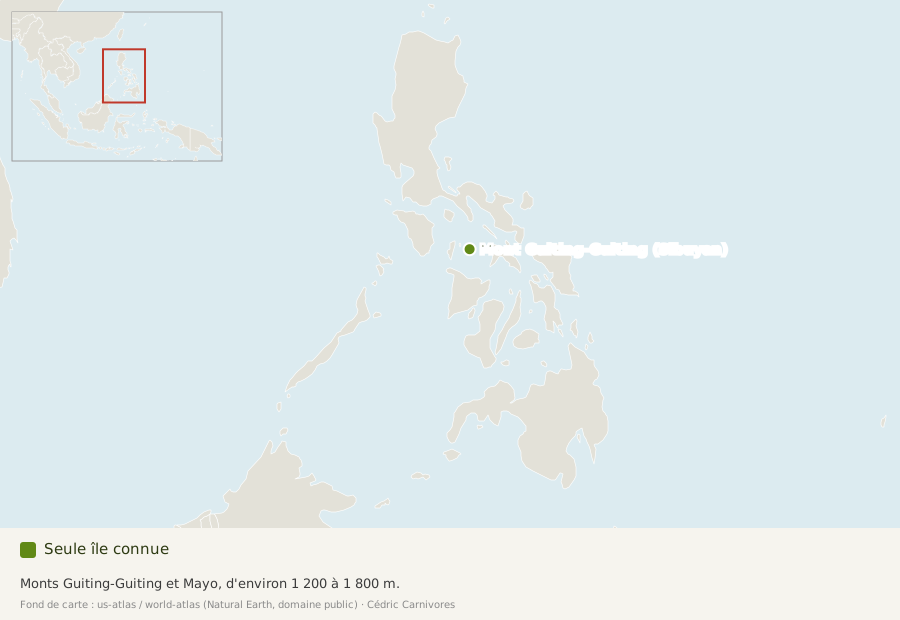
Endemic to Sibuyan island (Philippines): Mount Guiting-Guiting, neighbouring Mount Mayo and the ridge linking them.
Altitude: sources vary, from 1,200 to 1,800 m (Rybka and Cantley), 1,500 to 1,800 m (authors of the description) or 1,250 to 1,500 m (McPherson).
Habitat
- Open slopes, fairly sparse, with tall grasses, small shrubs and the fern Dipteris conjugata;
- the pitchers usually form buried in the soil or the vegetation, rarely in full sun.
Ecology
- Seeds that travel by water: having no wings, they are carried by rain and small streams, an adaptation to its isolated habitat.
- Neighbours: N. argentii grows with it at about 1,600 to 1,770 m. Lower down live N. armin (at about 750 m) and a plant close to N. alata (N. graciliflora). Other endemics share the mountain: Lobelia proctorii and Rhododendron rousei.
Relationships
It belongs to Danser's Insignes group, with N. burkei, N. merrilliana, N. ventricosa, N. insignis (New Guinea) and N. barcelonae (Luzon).
Natural hybrids
None known; a hybrid with N. argentii is possible.
Threats and protection
- “Vulnerable” for the IUCN, because of its tiny range.
- Threats: logging and mining threaten Mount Guiting-Guiting and its national park.
Did you know?
- It was first thought not to produce true upper pitchers and to form its pitchers only under moss: cultivation and new field observations have shown the opposite.
- In 2011, the Borneo Exotics nursery won a gold medal at the Chelsea Flower Show with this species.
Sources
- Wikipedia (English), Nepenthes sibuyanensis: Nerz 1998, Elmer 1911, 1996 expedition, specimens, detailed description, range, altitudes according to the authors, habitat, seeds, neighbours, Insignes group, status, threats, Chelsea 2011.