Nepenthes spectabilis Danser
Species sheet, updated on 29/10/2026.
At a glance
| Scientific name | Nepenthes spectabilis B. H. Danser, 1928 |
| Family | Nepenthaceae |
| Distribution | Northern Sumatra and Aceh, from the Lake Toba area to Mount Kemiri |
| Habitat | Mossy forest and stunted upper montane forest, from 1,400 to 2,200 m |
| Status | Vulnerable (IUCN) |
Etymology
- Nepenthes: see the genus sheet.
- spectabilis: a Latin word meaning “remarkable, worth seeing”.
History of the discovery
- 1920: Julius August Lörzing collected it on Mount Sibayak (Sumatra).
- 1928: Danser described it in his great monograph, based on Lörzing's specimen.
Description (how to recognise it)
- A climber with stems up to 6 m.
- Lower pitchers: about 12 cm; upper pitchers: up to about 26 cm.
- Colour: light green speckled with dark brown.
Distribution
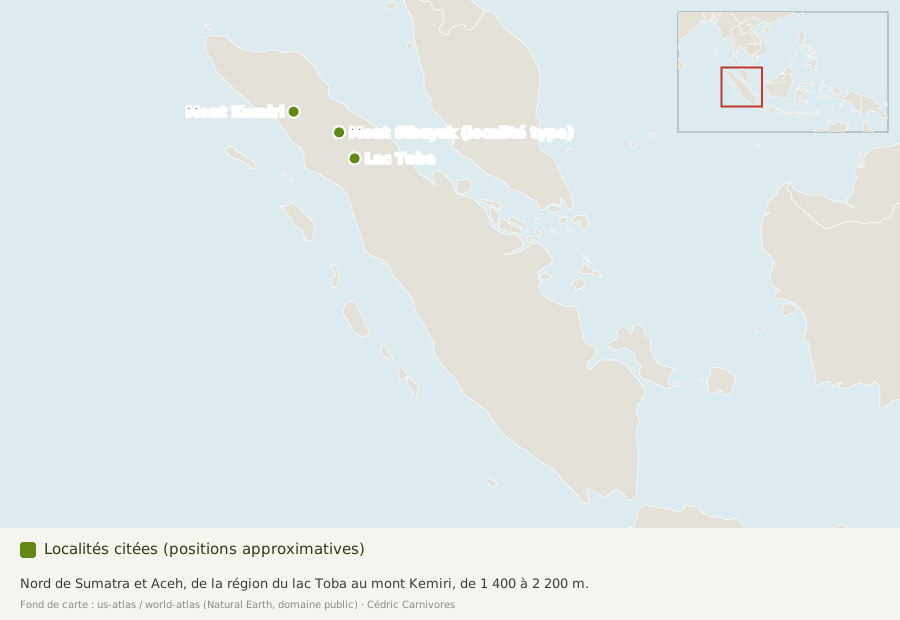
Endemic to northern Sumatra and Aceh (Indonesia), from the Lake Toba area northwards to Mount Kemiri. From 1,400 to 2,200 m.
Habitat
- Mossy forest and stunted upper montane forest;
- usually on the ground, sometimes on trees.
Natural hybrids
With N. gymnamphora, N. mikei, N. ovata, N. rhombicaulis, N. rigidifolia and N. tobaica.
Threats and protection
“Vulnerable” for the IUCN, because of its fragmented distribution. Some populations show signs of collection by collectors.
Sources
- Wikipedia (English), Nepenthes spectabilis: Danser 1928, Lörzing 1920, etymology, description, range, altitude, habitat, hybrids, status.