Nepenthes stenophylla Mast.
Species sheet, updated on 29/10/2026.
At a glance
| Scientific name | Nepenthes stenophylla Maxwell T. Masters, The Gardeners' Chronicle, 1890 |
| Former name | N. fallax Beck, 1895 (a synonym for most authors) |
| Family | Nepenthaceae; N. maxima group |
| Common names | Narrow-leaved pitcher-plant; in French “népenthès à feuilles étroites” |
| Distribution | Mountains of Borneo |
| Habitat | From 900 to 2,100 m altitude |
| Status | Least concern (IUCN, 2018) |
Photos in the wild
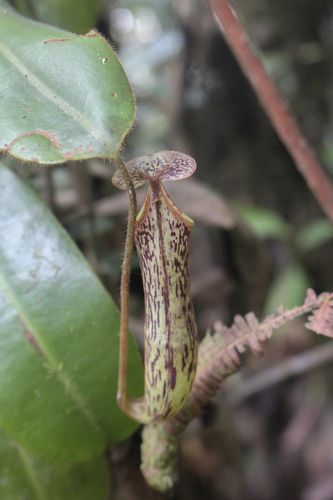
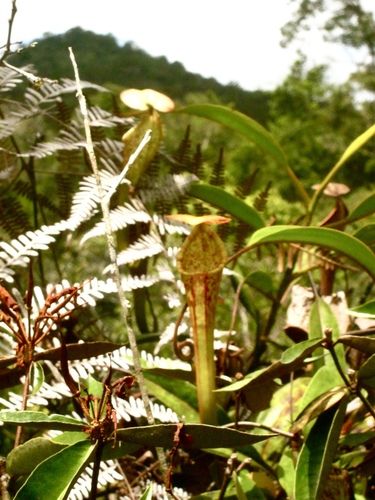
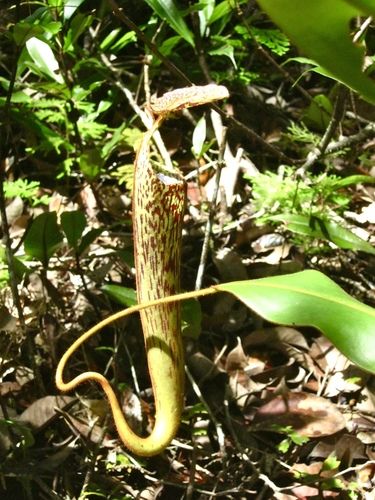
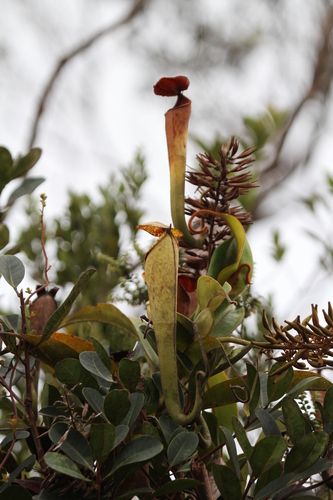
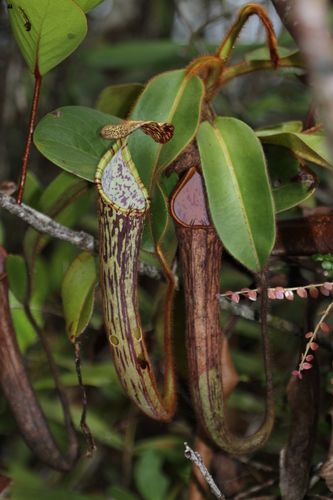
Etymology
- Nepenthes: see the genus sheet.
- stenophylla: from the Greek stenós, “narrow”, and phýllon, “leaf”: “narrow-leaved”.
- Its synonym fallax means “deceptive” in Latin.
History of the description
The English botanist Maxwell T. Masters described it in 1890 in The Gardeners' Chronicle. Günther Beck named it N. fallax in 1895. Most authors regard the two names as a single species. The specialist Jan Schlauer keeps N. fallax separate, with a rounder lid.
Description (how to recognise it)
- Pitchers: funnel-shaped, up to 25 cm tall.
- It belongs to the N. maxima group, a set of closely related species that are hard to tell apart.
Distribution
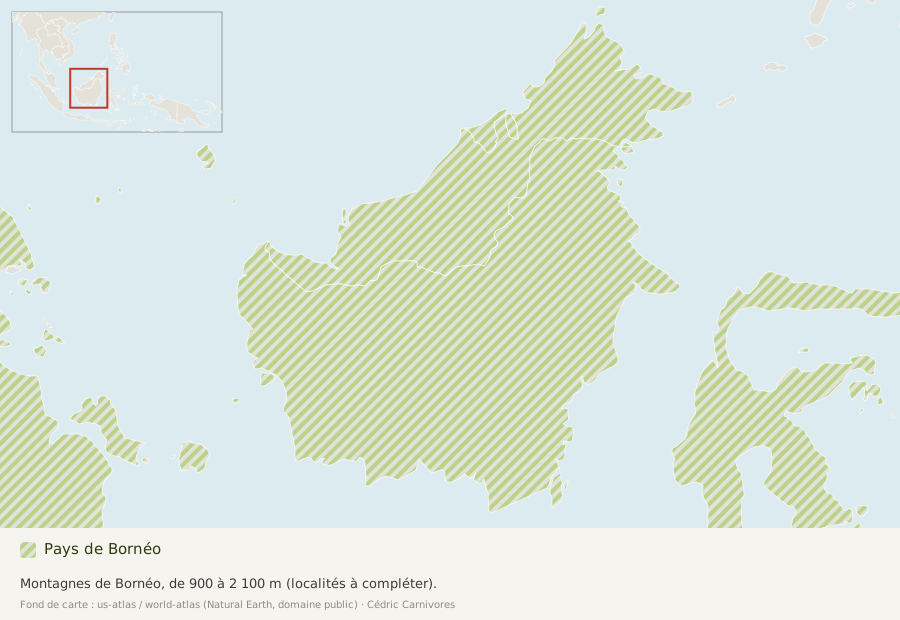
Endemic to Borneo, in the mountains, from 900 to 2,100 m.
Natural hybrids
With N. fusca, N. lowii (the “népenthès du Mentapok”), N. rajah, N. reinwardtiana, N. tentaculata and N. veitchii.
Threats and protection
“Least concern” for the IUCN (2018). N. fallax, when treated separately, is rated “vulnerable”.
Sources
- Wikipedia (English), Nepenthes stenophylla: Masters 1890, synonyms, fallax, description, range, altitude, maxima group, hybrids, statuses.