Nepenthes sumatrana (Miq.) Beck
Species sheet, updated on 29/10/2026.
At a glance
| Scientific name | Nepenthes sumatrana (Miquel) Günther Beck, 1895 |
| First name | N. boschiana var. sumatrana Miq., 1858 |
| Family | Nepenthaceae |
| Distribution | North Sumatra and West Sumatra, mainly around Sibolga |
| Habitat | Undisturbed dense lowland forest, on sandstone, from 0 to 800 m |
| Status | Critically endangered (IUCN, 2014) |
Etymology
- Nepenthes: see the genus sheet.
- sumatrana: “from Sumatra”.
History of the description
- February 1856: Johannes Elias Teijsmann collected it near Sibolga.
- 1858: Miquel made it a variety of N. boschiana; 1895: Beck raised it to species rank.
- Long confused with N. treubiana and N. longifolia.
- 1998: Ch'ien Lee was probably the first to knowingly see it again in the wild since Teijsmann.
Description (how to recognise it)
- A large climber up to 15 m, with leaves up to 55 cm.
- Pitchers: rosette pitchers about 10 cm, lower ones about 20 cm, upper ones up to 30 cm tall and 15 cm wide, funnel-shaped.
- A scent: the upper pitchers give off a sweet, fruity smell.
- The front of the mouth is raised, as in N. rafflesiana.
Distribution
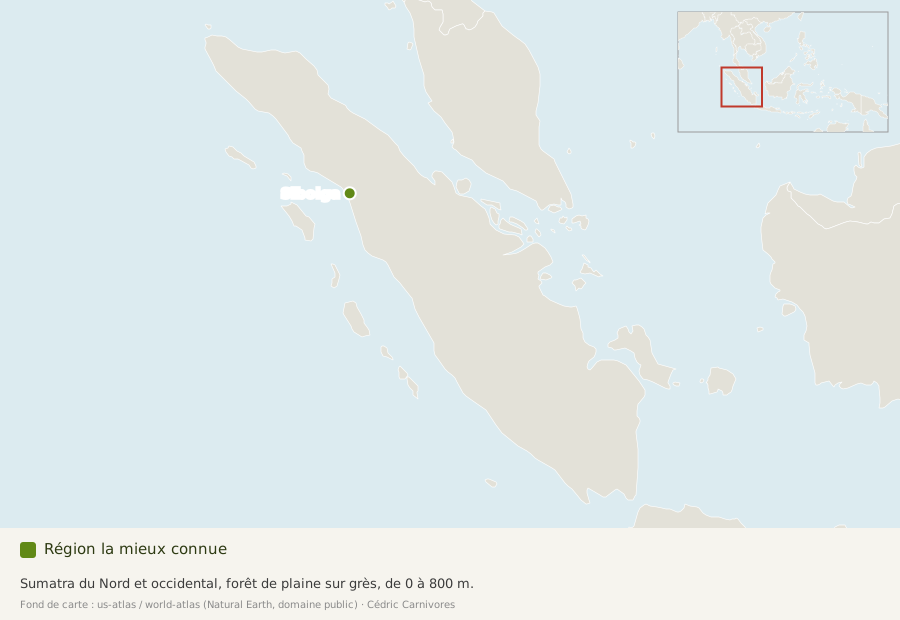
Endemic to North Sumatra and West Sumatra, known mainly from the hills around Sibolga. From 0 to 800 m.
Habitat
On the ground, in intact dense lowland forest, on sandstone. It has never been seen in logged forests or on farmland.
Natural hybrids
With N. eustachya, N. gracilis and N. mirabilis; doubtful with N. beccariana and N. longifolia.
Threats and protection
“Critically endangered” for the IUCN (2014). The rapid development around Sibolga is a particularly serious threat.
Sources
- Wikipedia (English), Nepenthes sumatrana: Miquel 1858, Beck 1895, Teijsmann 1856, Ch'ien Lee 1998, description, scent, range, altitude, habitat, hybrids, status, threats.