Nepenthes surigaoensis Elmer
Species sheet, updated on 30/10/2026.
At a glance
| Scientific name | Nepenthes surigaoensis Adolph Daniel Edward Elmer, Leaflets of Philippine Botany 8, 1915 |
| Family | Nepenthaceae |
| Distribution | Mount Masay massif (northern Mindanao) and Pantaron Range (central) |
| Habitat | Ridges in shady lower montane forest, from 800 to 1,200 m (1,750 m according to Elmer) |
Etymology
- Nepenthes: see the genus sheet.
- surigaoensis: from the Surigao Peninsula, where the type specimen was collected.
History of the description
- September 1912: Elmer collected it on the Lake Danao trail at the summit of Mount Masay, at about 1,700 m.
- Long merged into N. merrilliana, and even taken for a hybrid.
- 2007: Gronemeyer and Heinrich found it again; it was reinstated as a species in 2008.
Description (how to recognise it)
- A climber up to 5 m; leaves up to 40 cm by 5.
- Tendrils up to 120 cm, among the longest in the genus.
- Lower pitchers up to 24 cm by 9 (often 16 by 7.5); upper pitchers up to 15 cm, often keeping fringed wings.
- Inside of the pitchers yellow to orange, often spotted with purple or black; on Mount Masay, coarse orange-brown hairs on the pitchers and tendrils.
Distribution
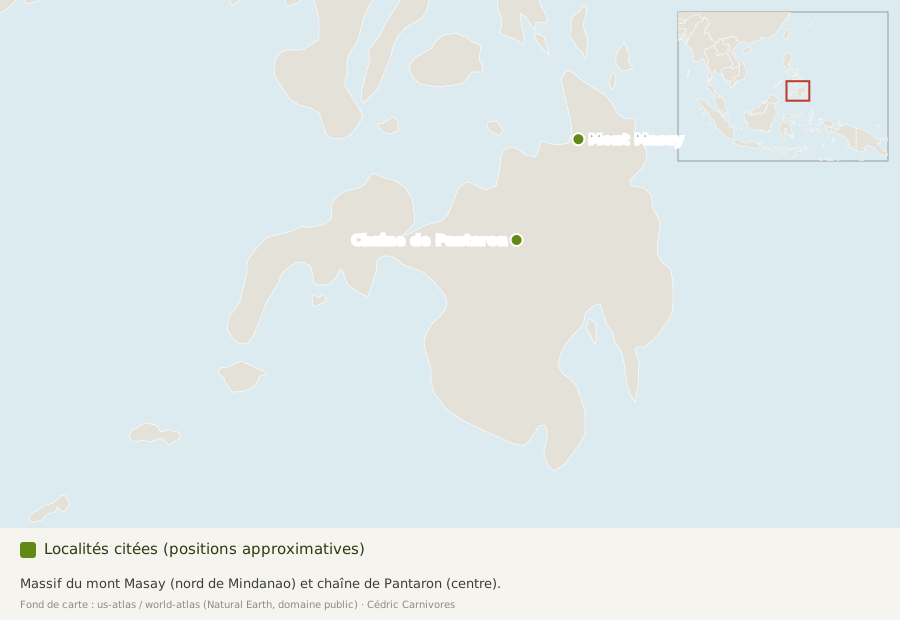
Endemic to Mindanao: Mount Masay massif (Mabaho Range, north) and a secondary peak of the Pantaron Range (central); perhaps also the Diuata Mountains.
Habitat
On the ground, on ridges, in shady lower montane forest, among dense vegetation up to 8 m tall.
Natural hybrids
None known.
Threats and protection
Not enough data to assess it; according to McPherson (2009), the populations are large and rarely visited.
Did you know?
- It differs from N. merrilliana in its leaves, its shady montane habitat and its fringed wings; it also resembles N. bellii, but is much larger.
Sources
- Wikipedia (English), Nepenthes surigaoensis: publication, etymology, history, description, range, altitude, habitat, status, relationships.