Nepenthes talangensis Nerz & Wistuba
Species sheet, updated on 29/10/2026.
At a glance
| Scientific name | Nepenthes talangensis Joachim Nerz & Andreas Wistuba, Carnivorous Plant Newsletter, 1994 |
| Family | Nepenthaceae |
| Distribution | Mount Talang and Bukit Gombak, West Sumatra |
| Habitat | Upper montane mossy forest, from 1,800 to 2,500 m |
| Status | Endangered (IUCN, 2000) |
Etymology
- Nepenthes: see the genus sheet.
- talangensis: “from Mount Talang”, a volcano in West Sumatra, with the Latin suffix -ensis, “coming from”.
History of the discovery
- 1918: H. A. B. Bünnemeijer collected it for the first time on Mount Talang.
- For decades, it was confused with N. bongso.
- 1994: the Germans Joachim Nerz and Andreas Wistuba described it as a species in the Carnivorous Plant Newsletter.
Description (how to recognise it)
- A climber about 3 m long, with dark green leaves.
- Lower pitchers: up to 10 cm; upper pitchers: up to 12 cm.
- A sticky fluid: its thick, viscous digestive fluid suggests that it also traps insects like flypaper.
Distribution
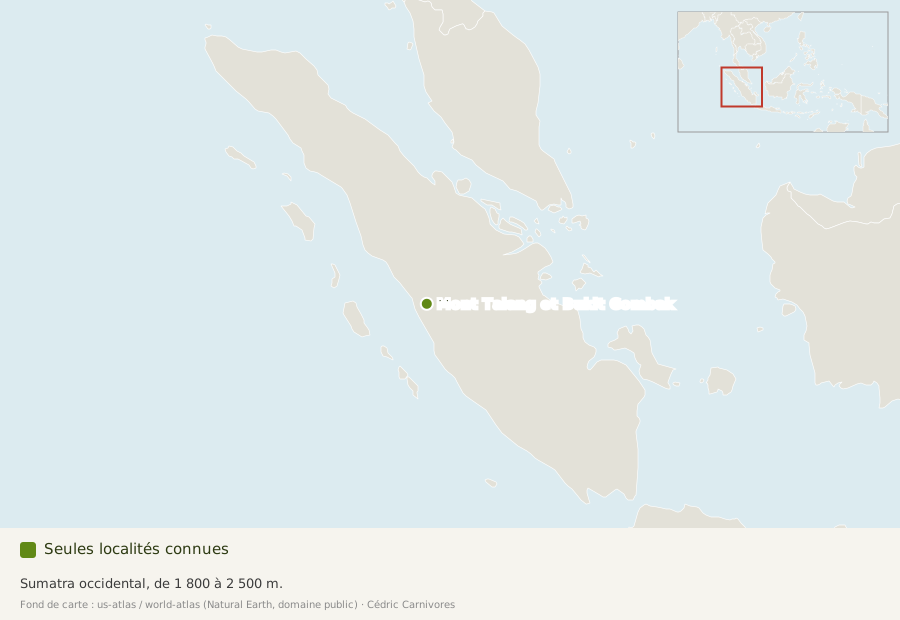
Endemic to West Sumatra (Indonesia): Mount Talang and the neighbouring hill of Bukit Gombak, from 1,800 to 2,500 m.
Habitat
- Upper montane mossy forest;
- usually on the ground.
Natural hybrids
| Hybrid | Other parent |
|---|---|
| N. × pyriformis | N. inermis |
| unnamed | N. bongso, N. gymnamphora |
Threats and protection
- “Endangered” for the IUCN (2000). Charles Clarke considered that, with a single mountain, it should normally have been rated “critically endangered”.
- Threats: the volcanic activity of Mount Talang, even though the plants survive there. The mountain is little visited and little developed. In 2009, Stewart McPherson considered it “not seriously threatened”.
Did you know?
- It lives on an active volcano, and its digestive fluid sticks like glue.
Sources
- Wikipedia (English), Nepenthes talangensis: Nerz & Wistuba 1994, Bünnemeijer 1918, etymology, description, viscous fluid, range, altitude, habitat, hybrids, status, threats (Clarke; McPherson 2009).