Nepenthes tentaculata Hook. f.
Species sheet, updated on 29/10/2026.
At a glance
| Scientific name | Nepenthes tentaculata Joseph Dalton Hooker, 1873 |
| Common name | In French “Népenthès frangée” |
| Family | Nepenthaceae |
| Distribution | Borneo (almost all mountains above 1,000 m) and Sulawesi |
| Habitat | Mossy forest and ridges, always on the ground, usually from 1,200 to 2,550 m |
| Status | Least concern (IUCN, 2018) |
Photos in the wild
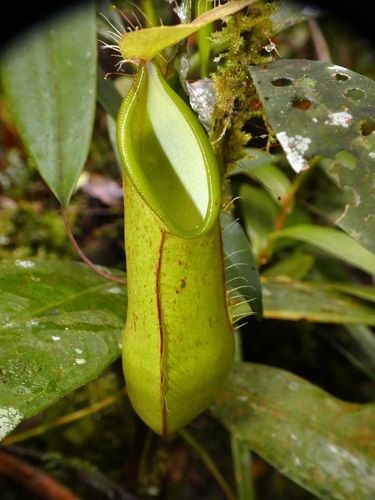
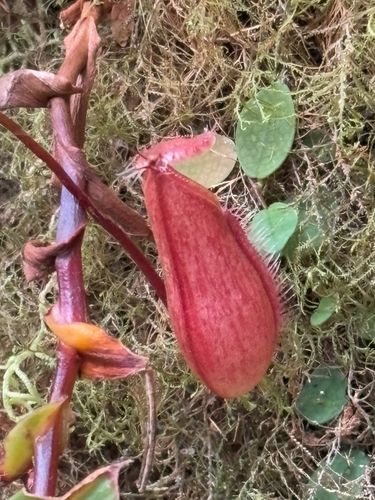
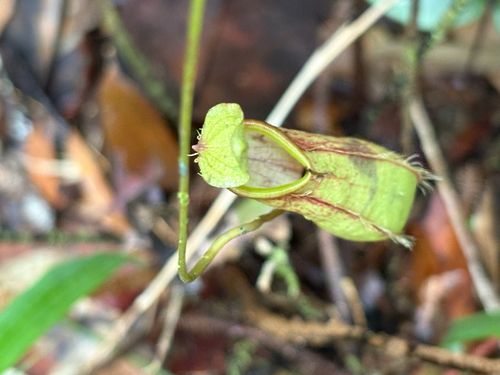
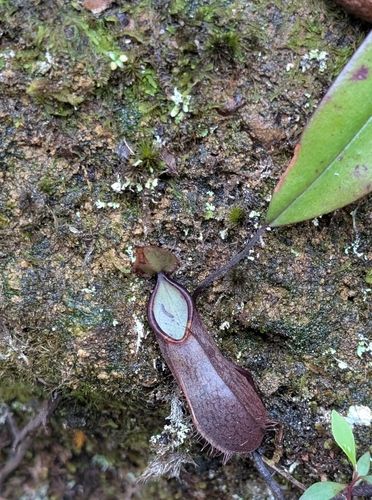
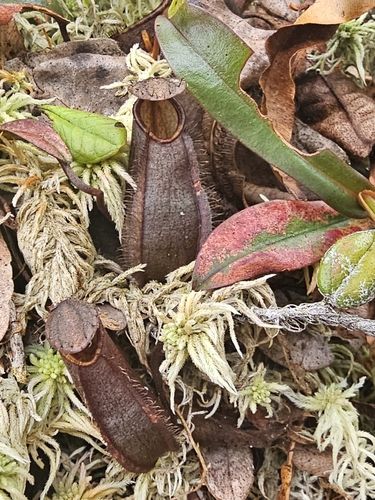
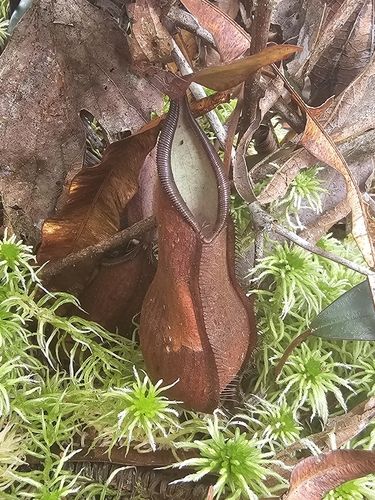
Etymology
- Nepenthes: see the genus sheet.
- tentaculata: “with tentacles”, for the filaments that cover the upper side of the lid.
History of the description
Hooker described it in 1873 from specimens collected in 1853 by the plant hunter Thomas Lobb. Danser corrected the description in 1928.
Description (how to recognise it)
- A small climber up to 3 m, which also forms rosettes; entirely hairless.
- Pitchers: usually less than 15 cm, exceptionally close to 30 cm; the lower pitchers have fringed wings.
- Lid: often lined with fine filaments near the edge, its “tentacles”; some forms have none.
Distribution
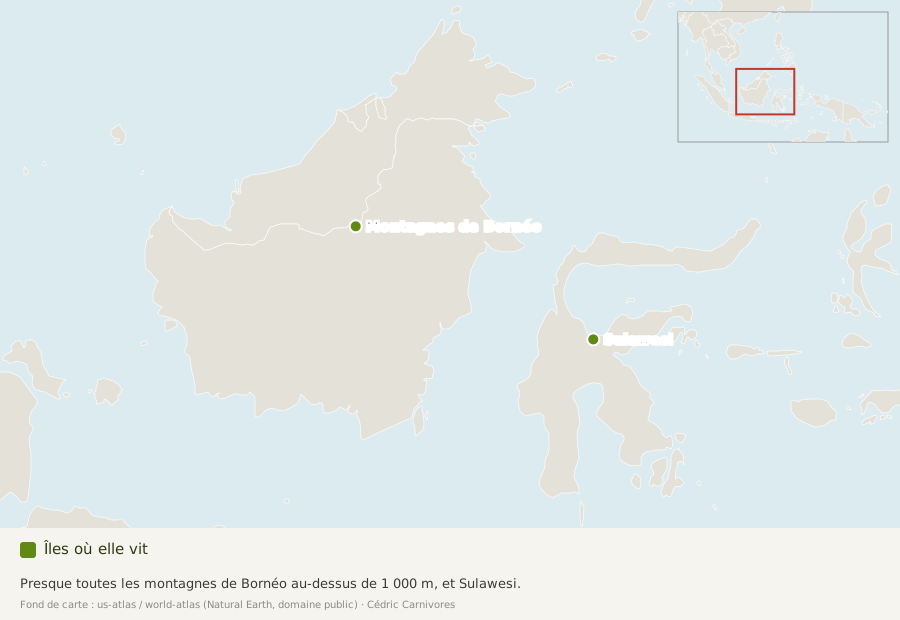
- Borneo, where it is very widespread: it is found on almost all mountains above 1,000 m;
- Sulawesi.
Usually from 1,200 to 2,550 m; on coastal mountains it comes down to about 740 m, sometimes 400 m.
Habitat
- Mossy forest and ridge vegetation;
- always on the ground, never on trees;
- often in clumps of sphagnum moss, and spreads by underground stems.
Varieties
var. imberbis and var. tomentosa.
Relationships
It belongs to the hamata group. It is mostly confused with N. muluensis, and is often described as a giant form of N. murudensis, which has no filaments.
Natural hybrids
More than a dozen, including with N. rajah, N. burbidgeae, N. hamata, N. glabrata, N. maxima, N. fusca and N. reinwardtiana. N. × sarawakiensis (with N. muluensis), described in 1993, is disputed.
Threats and protection
“Least concern” according to the IUCN (2018).
Sources
- Wikipedia (English), Nepenthes tentaculata: Hooker 1873, Lobb 1853, Danser 1928, etymology, description, range, altitude, habitat, varieties, hamata group, hybrids, status.
- N. glabrata, N. maxima, N. fusca, N. reinwardtiana sheets: hybrids with N. tentaculata.