Nepenthes tenuis Nerz & Wistuba
Species sheet, updated on 29/10/2026.
At a glance
| Scientific name | Nepenthes tenuis Joachim Nerz & Andreas Wistuba, Carnivorous Plant Newsletter, 1994 |
| Family | Nepenthaceae |
| Distribution | Tjampo River area, east of Taram, West Sumatra |
| Habitat | Mossy forest on sandstone ridges, from 1,000 to 1,200 m |
| Status | Endangered (IUCN, 2014) |
Etymology
- Nepenthes: see the genus sheet.
- tenuis: a Latin word meaning “thin, fine, slender”, for its small size and thin stems.
History: 45 years to see it again
- 24 August 1957: the botanist Willem Meijer collected it near Taram, in West Sumatra, on a sandstone ridge in the Tjampo River area, at about 1,000 m. There he also collected the type of N. adnata and the first specimen of N. longifolia.
- 1994: Nerz and Wistuba described it from this single specimen and a black-and-white photo from 1957. Several expeditions searched for it in vain.
- 1997: Jebb and Cheek placed it, “with some hesitation”, under N. dubia; Clarke reinstated it in 2001.
- Late 2002: Wistuba, Nerz, Michael Schach and others found it again.
Description (how to recognise it)
- A slender climber: stems 2 to 3 mm thick.
- Leaves: small, narrow, 5 to 6 cm by 1 to 1.5.
- Tiny upper pitchers: usually 2.5 to 4.5 cm high, funnel-shaped. It may be the second smallest pitcher in the genus, after N. argentii.
- Colours: pitchers yellowish green, often spotted with reddish brown; peristome yellow to dark brown.
- Glands cover the whole inner wall.
Distribution
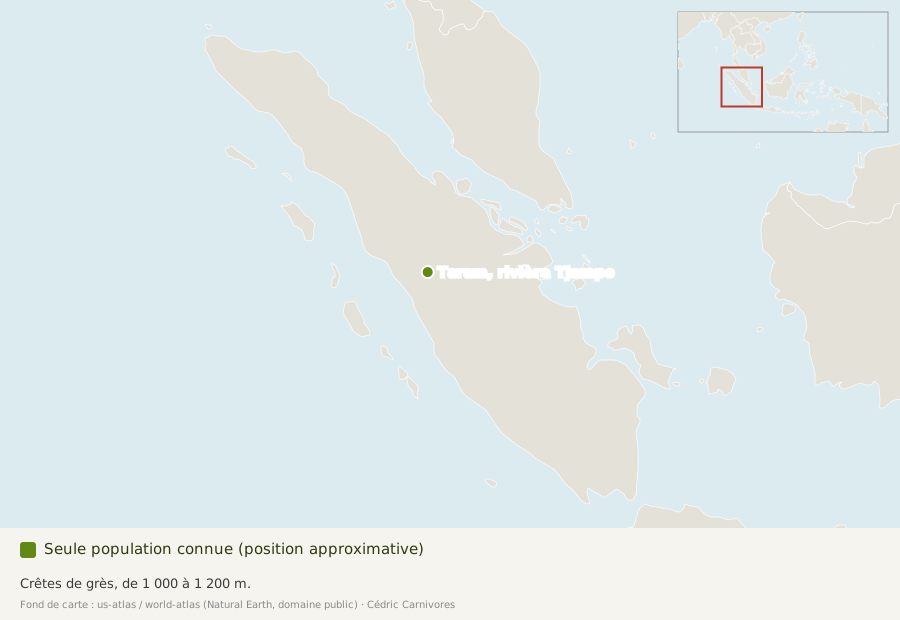
Endemic to Sumatra: the only known population is in West Sumatra, in the Tjampo River area, east of Taram. From 1,000 to 1,200 m.
Habitat
- Mossy forest and open submontane forest, on top of sandstone ridges;
- the lower pitchers often form half buried in moss, which makes the plant hard to find.
Ecology
It grows with N. adnata, near N. albomarginata, N. ampullaria, N. eustachya, N. gracilis, N. longifolia and N. reinwardtiana.
Relationships
- Different from N. dubia: shorter and wider lid, never folded back beyond 180°, pitchers speckled with red.
- For Clarke, its similarities with N. talangensis and N. jacquelineae show a recent diversification of Nepenthes in the non-volcanic mountains of the Barisan.
Natural hybrids
None known.
Threats and protection
“Endangered” according to the IUCN (2014). Main threat: forest fires lit to clear farmland.
Sources
- Wikipedia (English), Nepenthes tenuis: Nerz & Wistuba 1994, Meijer 1957, rediscovery in 2002, synonymy, description, range, altitude, habitat, neighbouring species, relationships (Clarke), status, threats.