Nepenthes tobaica Danser
Species sheet, updated on 29/10/2026.
At a glance
| Scientific name | Nepenthes tobaica B. H. Danser, 1928 |
| Family | Nepenthaceae |
| Distribution | Sumatra: mainly around Lake Toba; also Mount Sorik Merapi and Lake Kerinci |
| Habitat | Exposed places and forest edges, montane peat bog at Kerinci; from 380 to 1,800 m (up to 2,750 m according to Jebb and Cheek) |
| Status | Least concern (IUCN, 2018) |
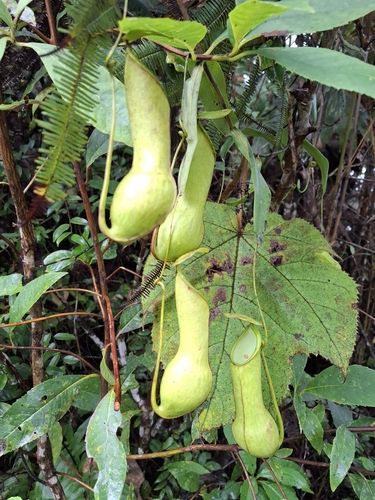
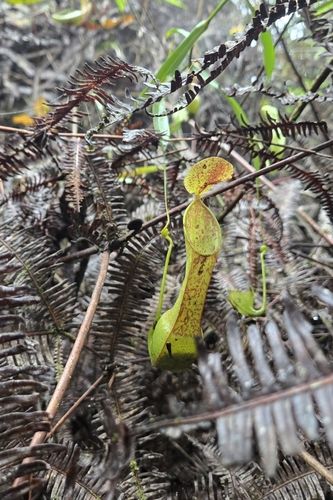
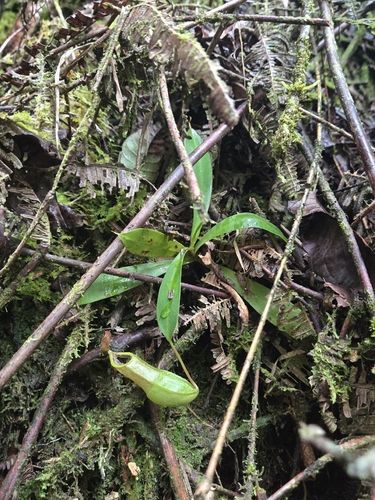
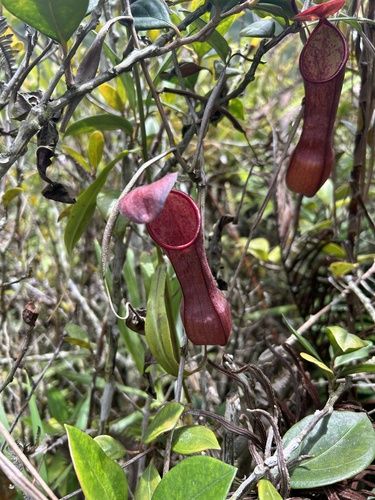
Photos in the wild
Etymology
- Nepenthes: see the genus sheet.
- tobaica: from Lake Toba, the large volcanic lake in northern Sumatra.
History of the description
- 1856: the gardener and botanist Johannes Elias Teijsmann made the first known collection, probably in the Batak lands.
- 1928: Danser described it.
- It has often been confused with N. angasanensis.
Description (how to recognise it)
- A climber up to 7 m.
- Lower pitchers: up to 20 cm by 4; upper pitchers: up to 25 cm by 5.
- Colours: some plants have dark purple lower pitchers; in some forms, the underside of the lid is bright red.
Distribution
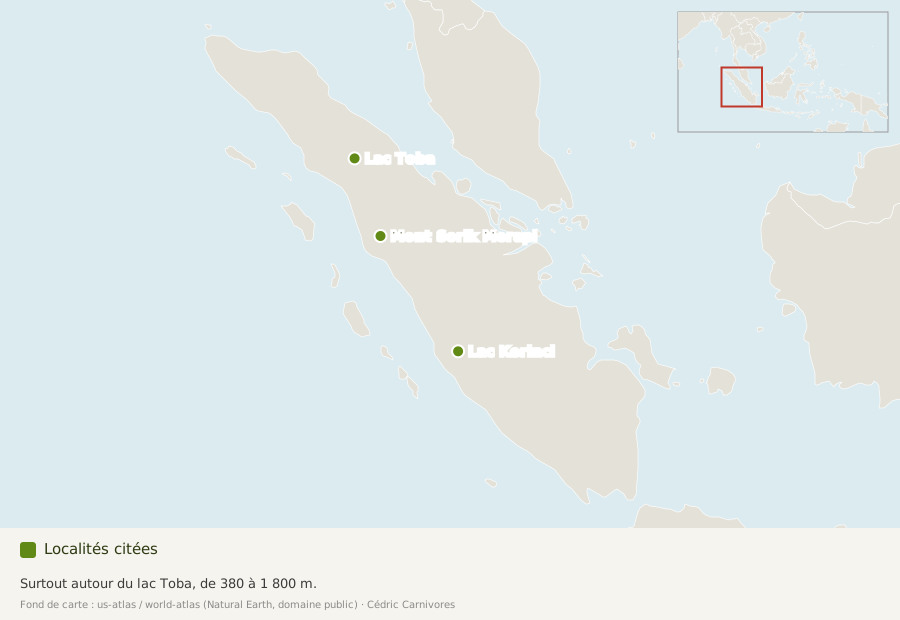
Endemic to Sumatra: especially abundant around Lake Toba; also near Mount Sorik Merapi and Lake Kerinci (Jambi).
Habitat
- Usually on the ground, in exposed places and at forest edges;
- also in the montane wooded peat bog near Lake Kerinci, at about 1,100 m, with N. spathulata and other species.
Natural hybrids
Five: with N. ampullaria, N. reinwardtiana, N. rhombicaulis, N. spathulata and N. spectabilis.
Did you know?
- Some plants sold under this name are said to be cultivated hybrids N. khasiana × N. ventricosa.
Sources
- Wikipedia (English), Nepenthes tobaica: Danser 1928, Teijsmann 1856, etymology, range, altitudes, habitat, description, hybrids, confusions, status.
- Wikipedia (English), Nepenthes spathulata: Lake Kerinci peat bog.