Nepenthes treubiana Warb.
Species sheet, updated on 30/10/2026.
At a glance
| Scientific name | Nepenthes treubiana Otto Warburg, 1891 |
| Family | Nepenthaceae |
| Distribution | McCluer Gulf, Fakfak Peninsula and Misool Islands (Western New Guinea) |
| Habitat | Cliffs and coastline |
| Status | Least concern (IUCN, 2014) |
Etymology
- Nepenthes: see the genus sheet.
- treubiana: in honour of the botanist Melchior Treub, director of the Buitenzorg (Bogor) botanical garden.
Description (how to recognise it)
- According to Macfarlane (1908): robust climber, stem 6 to 10 m; large leathery leaves 15 to 45 cm by 7 to 8 cm, on a winged petiole 4 to 10 cm long, with 7 to 10 pairs of longitudinal veins; tendril 20 to 35 cm.
- Pitchers 10 to 20 cm by 4 to 7 cm, with reddish-brown hairs when young; the lower ones flask-shaped or swollen, with wings 5 to 10 mm wide; the upper ones funnel-shaped, green marbled with purple; peristome 15 to 20 mm; round lid; the inside is almost entirely shiny and glandular (no waxy zone). Clusters 40 to 60 cm long.
Distribution
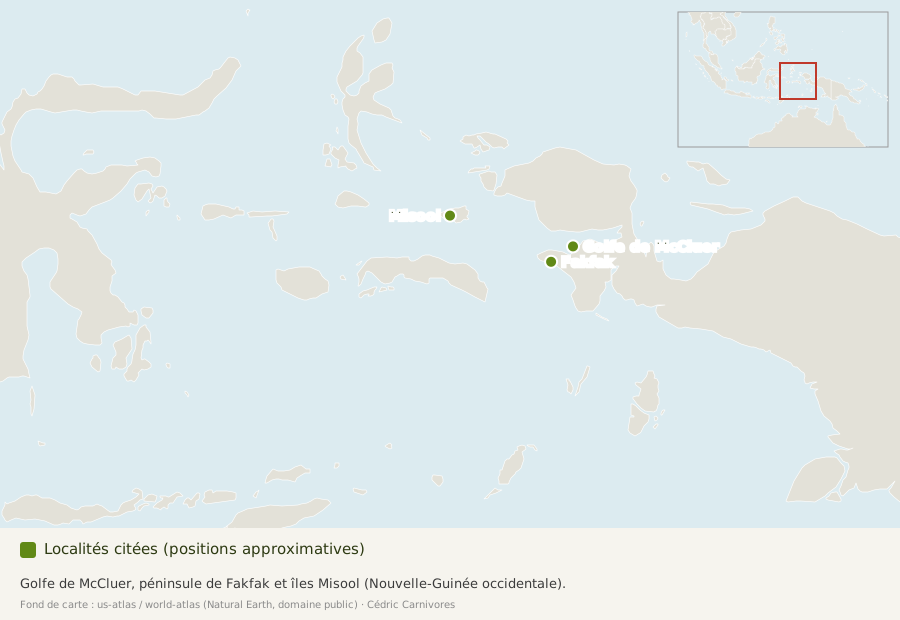
Western New Guinea: cliffs of the McCluer Gulf and coastline of the Fakfak Peninsula; large populations on the island of Misool and several small neighbouring islands. Regions where most of the herbarium specimens and observations published in GBIF come from (number of records): West Papua (11), New Guinea (3).
Habitat
Cliffs and coastal areas. Macfarlane (1908) quotes Warburg, who described it: “not rare on the coast of the McCluer Gulf, in Dutch New Guinea, on sandstone slopes”; he also included a collection from Sumatra (Sibolga).
Natural hybrids
None known.
Sources
- Wikipedia (English), Nepenthes treubiana: author, etymology, range, habitat, hybrids, status.
- Macfarlane, Das Pflanzenreich IV.111: Nepenthaceae, 1908 (archive.org): description, localities and altitudes of the specimens (translated from Latin and German).
- GBIF, Nepenthes treubiana: author, original publication, countries and localities of herbarium specimens and observations.