Nepenthes truncata Macfarl.
Species sheet, updated on 29/10/2026.
At a glance
| Scientific name | Nepenthes truncata John Muirhead Macfarlane, 1911 |
| Synonym | N. megamphora Merr. & Quis. (1915) |
| Family | Nepenthaceae |
| Distribution | Philippines: Mindanao, Dinagat and Leyte |
| Habitat | From sea level to 1,500 m |
| Status | Endangered (IUCN, 2000) |
Etymology
- Nepenthes: see the genus sheet.
- truncata: from the Latin truncatus, “ending abruptly”, for its leaves that look cut off cleanly, heart-shaped at the base of the pitcher.
History of the description
The Scottish-born American botanist John Muirhead Macfarlane described it in 1911, in the publications of the botanical laboratory of the University of Pennsylvania.
Description (how to recognise it)
- Broad, heart-shaped leaves, as if truncated.
- Very large pitchers, up to 40 cm high.
- With age, the peristome of the pitchers becomes strongly coloured.
Distribution
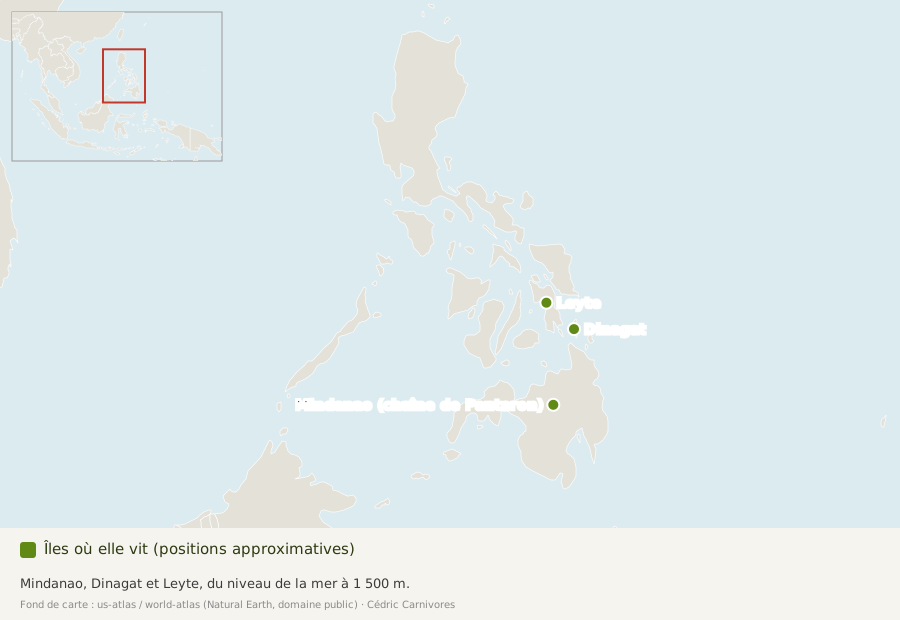
Endemic to the Philippines: Mindanao, Dinagat and Leyte, from sea level to 1,500 m. For example, one pitcher was found at 230 m in northern Mindanao.
Habitat
It grows on the ground, but also on trees: an epiphytic plant was recorded in the Pantaron Range, near San Fernando.
Relationships
N. robcantleyi, with almost black pitchers, was first taken for a dark highland form of N. truncata. They are the only two Philippine species in section Regiae.
Natural hybrids
| Hybrid | Other parent |
|---|---|
| N. × truncalata | N. alata |
| unnamed | N. mindanaoensis |
| unnamed, doubtful | N. petiolata |
Threats and protection
“Endangered” according to the IUCN (2000 assessment).
Did you know?
- On 29 September 2006, at the Lyon botanical garden, a pitcher was photographed with a decomposing mouse inside: the first known capture of a mammal by this species in a greenhouse. In the wild, N. rajah and N. rafflesiana sometimes catch small mammals.
Sources
- Wikipedia (English), Nepenthes truncata: Macfarlane 1911, etymology, synonym, pitchers, range, altitude, epiphytism, hybrids, status, Lyon mouse.