Nepenthes veitchii Hook. f.
Species sheet, updated on 29/10/2026.
At a glance
| Scientific name | Nepenthes veitchii Joseph Dalton Hooker, 1859 |
| Family | Nepenthaceae |
| Common names | Veitch's pitcher-plant; in French népenthès de Veitch |
| Distribution | Northwestern Borneo and part of Kalimantan (Indonesian Borneo) |
| Habitat | Lowland dipterocarp forest near rivers, mossy montane ridges, from 0 to 1,600 m |
| Status | Least concern (IUCN, 2018) |
Photos in the wild
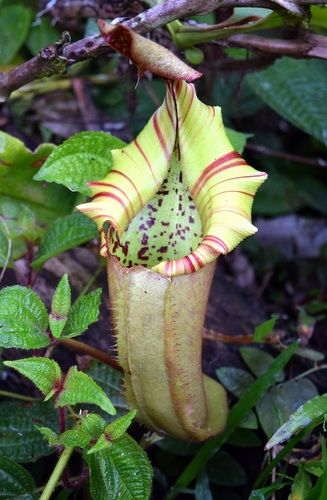
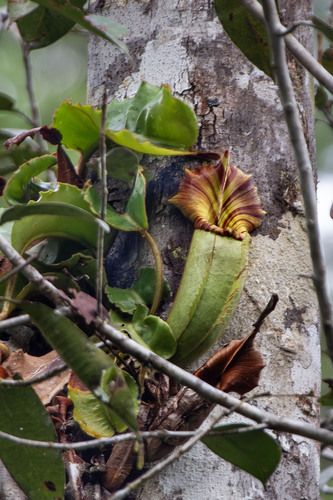
Etymology
- Nepenthes: see the genus sheet.
- veitchii: in honour of James Veitch, of the famous English Veitch nursery, which brought a great many exotic plants to Europe in the 19th century.
History of the discovery
- 1859: Joseph Dalton Hooker described it. He compared the fine ribs on the rim of the pitcher to fish gills.
- 1865: the Italian botanist Odoardo Beccari found it at the top of Mount Santubong (Sarawak). He noted its “rich orange colour” and the upright mouth of its pitchers.
Description (how to recognise it)
- Pitchers with an orange mouth: their opening, often orange, is edged with a wide peristome with fine ribs.
- Size: some pitchers measure about 25 cm.
- A plant that “hugs” trees: most often epiphytic, it grows on trunks. The botanist Frederick Burbidge observed that its leaves are arranged in two rows and that some clasp the trunk of the tree.
- A Bario form, on the highlands, seems on the contrary to be strictly terrestrial: it has never been seen climbing trees.
- Its relatives: it is said to be close to N. robcantleyi, from the Philippines, and is compared to N. truncata.
Distribution
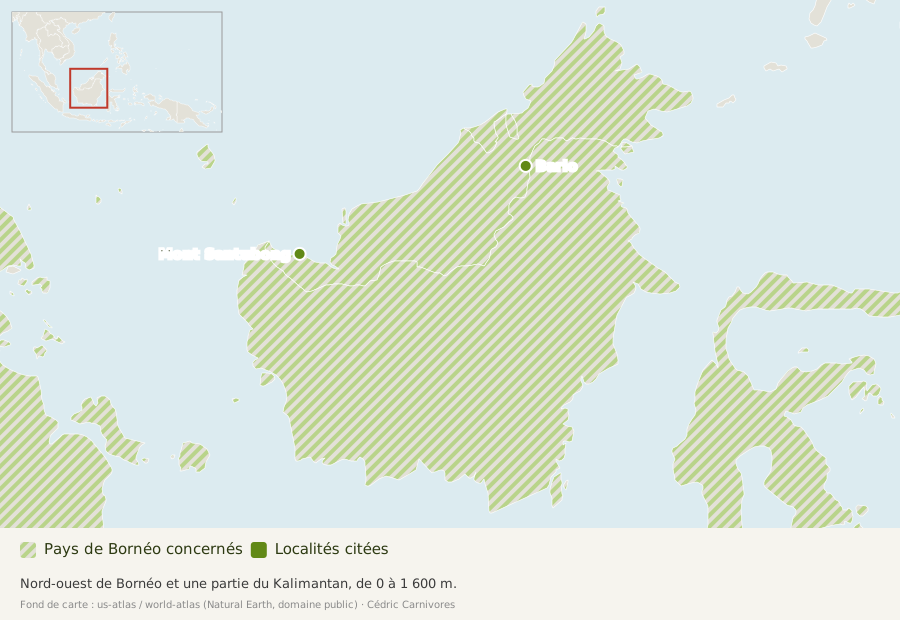
Endemic to Borneo: widespread in the northwest of the island, with populations in part of Kalimantan. From sea level to 1,600 m.
Habitat
- Lowland dipterocarp forest, often near rivers;
- ridges covered with mossy forest in the mountains.
Natural hybrids
With N. albomarginata, N. chaniana, N. fusca, N. hurrelliana, N. lowii and N. stenophylla; possibly also with N. faizaliana (uncertain).
Threats and protection
“Least concern” according to the IUCN (2018 assessment).
Did you know?
- Hooker saw fish gills in the rim of its pitchers.
Sources
- Wikipedia (English), Nepenthes veitchii: Hooker 1859, etymology, Beccari 1865, description, epiphytic habit (Burbidge), Bario form, range, altitude, habitat, relationships, hybrids, status.