Nepenthes ventricosa Blanco
Species sheet, updated on 29/10/2026.
At a glance
| Scientific name | Nepenthes ventricosa Francisco Manuel Blanco, Flora de Filipinas, 1837 |
| Family | Nepenthaceae |
| Distribution | Philippines: Luzon, Panay and Sibuyan |
| Habitat | Mountains, from 1,000 to 2,000 m |
| Status | Least concern (IUCN, 2018) |
Photos in the wild
Etymology
- Nepenthes: see the genus sheet.
- ventricosa: from the Latin ventricosus, “pot-bellied, swollen”, for its bulging pitchers.
History of the description
The Spanish Augustinian friar Francisco Manuel Blanco described it in 1837 in his Flora de Filipinas, the first major flora of the Philippines. It is therefore one of the oldest described species of the archipelago.
Description (how to recognise it)
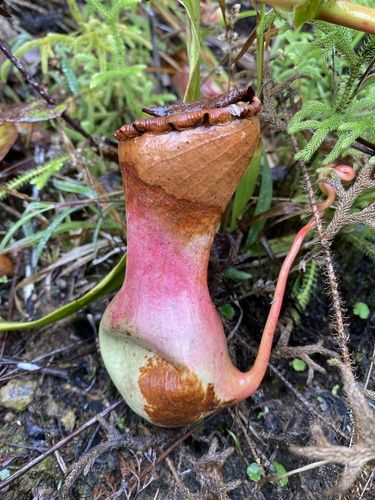
- Numerous pitchers, up to 20 cm high.
- A marked waist in the middle of the pitcher, a small mouth and a usually thin peristome.
- Colours: from ivory white to red.
Distribution
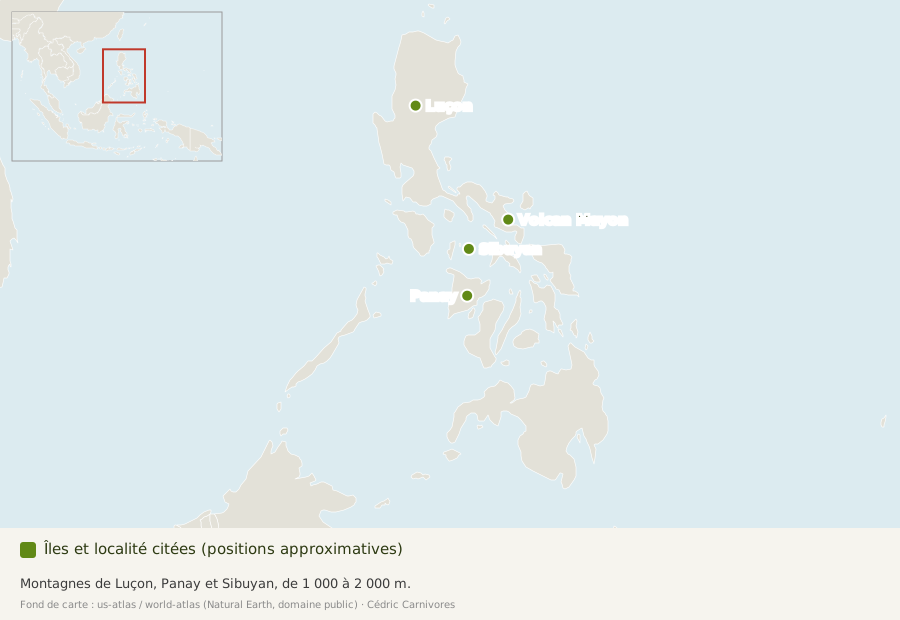
Endemic to the Philippines: Luzon, Panay and Sibuyan. It is a mountain species, from 1,000 to 2,000 m; for example, it has been photographed on Mayon Volcano, on Luzon.
Relationships
It belongs to the Insignes group with N. burkei and N. sibuyanensis, its closest relatives.
Forms
- f. luteoviridis (Fukatsu, 1999): horticultural name without a valid description.
Natural hybrids
With N. alata: N. × ventrata, one of the most widespread Nepenthes hybrids in cultivation.
Ecology
Its pitchers harbour larvae of the tiger mosquito (Aedes albopictus), which have been the subject of a scientific study. Researchers have also isolated several digestive enzymes from its fluid.
Threats and protection
“Least concern” according to the IUCN (assessment by C. Clarke, 2018).
Sources
- Wikipedia (English), Nepenthes ventricosa: Blanco 1837, etymology, pitchers, range, altitude, relationships, form, hybrid, tiger mosquito, enzymes, status.
- (“N. × ventrata, one of the most widespread hybrids in cultivation”: general knowledge from the trade; from one source, not confirmed)