Nepenthes villosa Hook. f.
Species sheet, updated on 29/10/2026.
At a glance
| Scientific name | Nepenthes villosa Joseph Dalton Hooker, Icones plantarum, 1852 |
| Family | Nepenthaceae |
| Common names | Villose pitcher-plant; in French “népenthès velu” |
| Distribution | Upper slopes of Mount Kinabalu and Mount Tambuyukon, Sabah (Borneo) |
| Habitat | Mossy and subalpine forest, serpentine soils, from 2,300 to 3,240 m |
| Status | Least concern (IUCN) |
Photos in the wild
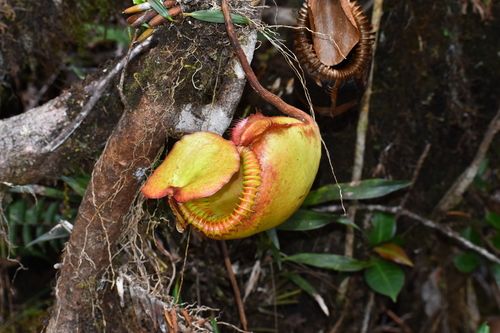
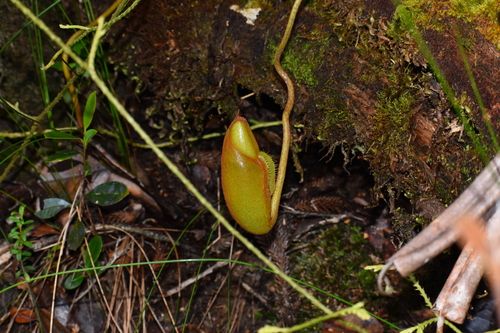
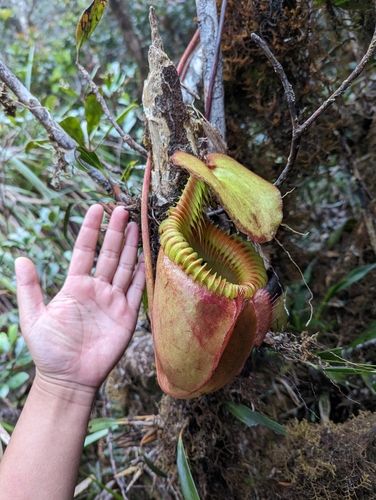
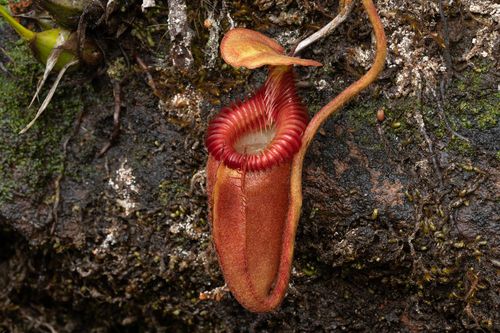
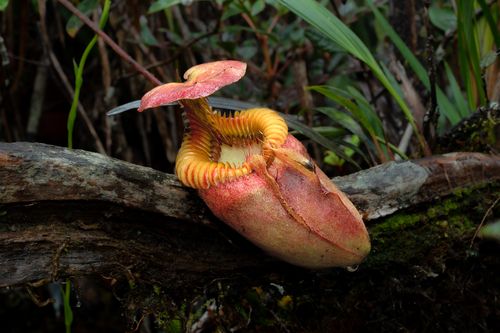
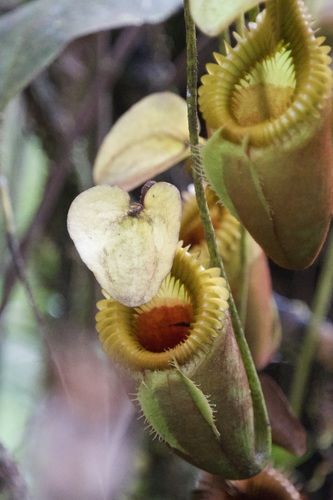
Etymology
- Nepenthes: see the genus sheet.
- villosa: a Latin word meaning “hairy”, for the long brown hairs that cover the whole plant.
History of the discovery
Joseph Dalton Hooker described it in 1852. Hugh Low and Spenser St. John are said to have collected it during the second ascent of Kinabalu, in 1858 (the collection and description dates seem contradictory in the source, not confirmed).
Description (how to recognise it)
- Habit: a weak climbing plant, rarely more than 60 cm high, although its stem can reach 8 m.
- Pitchers: up to 25 cm high and 9 cm wide, with two fringed wings on the front.
- Peristome: cylindrical, up to 2 cm wide, with very well-developed teeth and ribs.
- Lid: heart-shaped, pointed.
- Hairs: long brown hairs on all parts of the plant.
Distribution
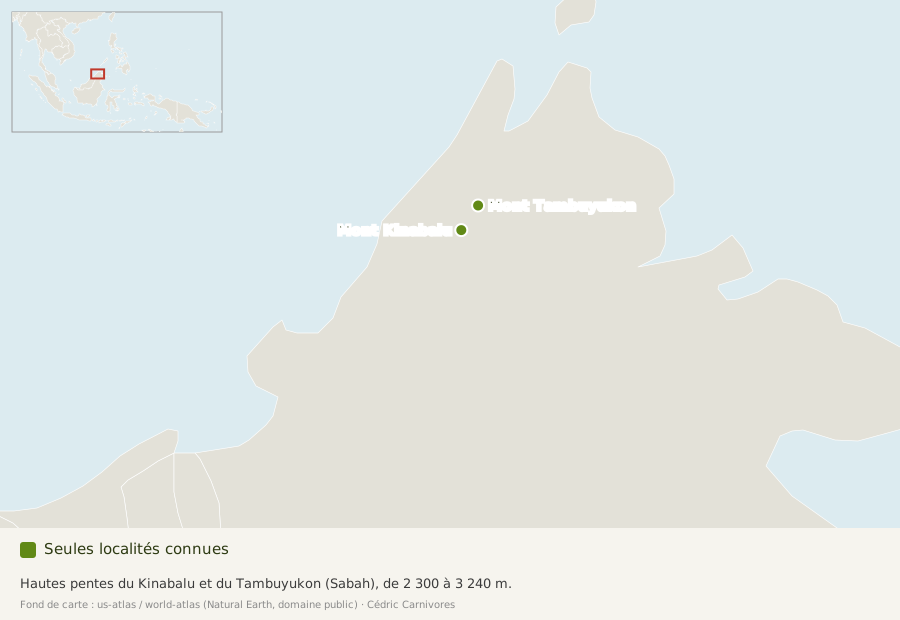
Endemic to the upper slopes of Mount Kinabalu and neighbouring Mount Tambuyukon, in Sabah (northeastern Borneo).
- Usually from 2,300 to 3,240 m: it is the Bornean Nepenthes that grows highest.
- On Tambuyukon, it is more frequent lower down, between 1,600 and 1,900 m.
Habitat
- Mossy forest and subalpine forest dominated by trees of the genera Dacrydium and Leptospermum;
- open areas among shrubs, grasses and rocks;
- only on ultramafic soils (serpentine).
Natural hybrids
| Hybrid | Other parent |
|---|---|
| N. × harryana | N. edwardsiana |
| N. × kinabaluensis | N. rajah |
Threats and protection
“Least concern” according to the IUCN. All its populations are in Kinabalu National Park, where collecting is prohibited. Along the summit trail, hikers have caused the populations to decline.
Did you know?
- It is the Bornean Nepenthes that lives highest: up to 3,240 m on Kinabalu.
Sources
- Wikipedia (English), Nepenthes villosa: Hooker 1852, Low and St. John, etymology, description, range, altitudes, habitat, hybrids, status.