Nepenthes viridis Micheler, Gronem., Wistuba, Marwinski, W. Suarez & V. B. Amoroso
Species sheet, updated on 30/10/2026.
At a glance
| Scientific name | Nepenthes viridis Michael Micheler, Thomas Gronemeyer, Andreas Wistuba, Dennis Marwinski, Wilbert Suarez & Victor B. Amoroso, Das Taublatt 76, 2013 |
| Family | Nepenthaceae |
| Distribution | Coasts of Dinagat, Samar and nearby islets (Philippines) |
| Habitat | Humus-rich and rocky soils in full sun, islet cliffs, at low altitude |
Etymology
- Nepenthes: see the genus sheet.
- viridis: from the Latin, “green”: its yellowish-green pitchers stay green even in full sun.
History of the description
- 1859: the name was used by Teijsmann, but without a description.
- 2007: Thomas Gronemeyer and Volker Heinrich found it and took it for a green form of N. alata.
- 23 August 2012: collection of the type specimen on Dinagat; announced online in September 2012, described in 2013.
Description (how to recognise it)
- A climber about 4 m long.
- Yellowish-green pitchers, almost white inside.
- Lower pitchers up to 16.5 cm by 4; narrow upper pitchers, up to 18 cm by 2.4.
- Strongly domed lid with a keel; front of the peristome raised and crenate; branched spur on the lower pitchers.
Distribution
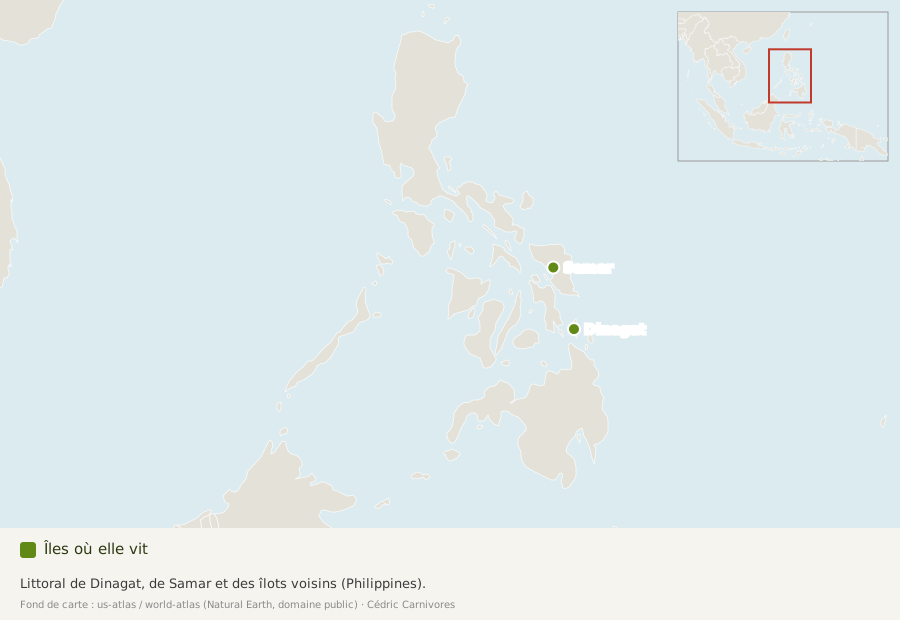
Endemic to the Philippines: coasts of the islands of Dinagat and Samar and nearby islets, at low altitude.
Habitat
Mostly on the ground, on humus-rich and rocky soils, often in full sun; also on the almost vertical cliffs of the islets. Droughts can make it wither.
Natural hybrids
None certain; crosses are more likely on Samar, where it grows alongside N. merrilliana and N. alata in the broad sense.
Did you know?
- It belongs to the N. alata group; N. higaonon (2025) is a close relative.
Sources
- Wikipedia (English), Nepenthes viridis: publication, etymology, history, description, range, habitat, hybrids, N. alata group.
- Wikipedia (English), Nepenthes higaonon: relationships.