Nepenthes vogelii Schuit. & de Vogel
Species sheet, updated on 29/10/2026.
At a glance
| Scientific name | Nepenthes vogelii André Schuiteman & Ed de Vogel, Blumea, 2002 |
| Family | Nepenthaceae |
| Distribution | Borneo: northern Sarawak, southern Sabah, West Kalimantan |
| Habitat | Submontane and lower montane forest, mostly on trees, from 1,000 to 1,500 m |
| Status | Least concern (IUCN, 2018) |
Etymology
- Nepenthes: see the genus sheet.
- vogelii: in honour of Art Vogel, former head of the greenhouses at the Leiden botanical garden (Netherlands), who grew the plant to maturity.
History of the description
- 1961: J. A. R. Anderson collected a specimen on Mount Api (Gunung Mulu National Park), filed as N. fusca.
- 1969: Shigeo Kurata noticed that it did not really match N. fusca.
- It entered cultivation through Ch'ien Lee's Malesiana Tropicals nursery, under the name “Nepenthes spec. 4”.
- 1997: a seedling was collected in the Kelabit Highlands (Sarawak), then raised in Leiden by Art Vogel.
- 2002: Schuiteman and de Vogel described it from this cultivated plant.
Description (how to recognise it)
- Lower pitchers: cylindrical, with a small horizontal mouth, without wings; pale cream to yellowish speckled with dark, with a striped peristome.
- Lid: broadly triangular, without appendages underneath.
- Upper pitchers: funnel-shaped, from very narrow to swollen at the top.
Distribution
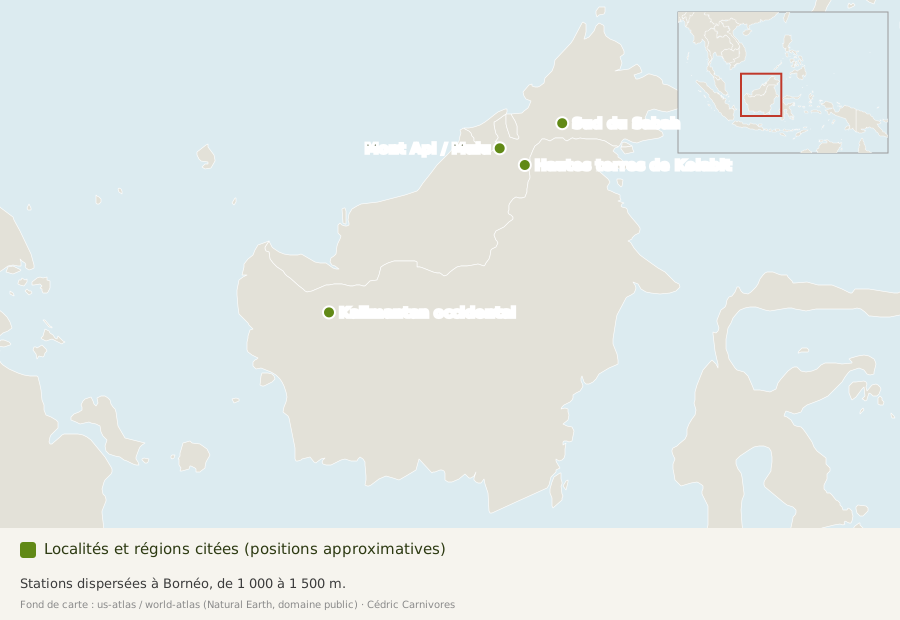
Endemic to Borneo: it was thought to be limited to northern Sarawak; it is now also known from southern Sabah and West Kalimantan, but only from scattered sites. From 1,000 to 1,500 m.
Habitat
- Usually on trees (as an epiphyte), in submontane forest and tall lower montane forest;
- the type plant grew on the ground, in the moss of a wet kerangas forest;
- with N. stenophylla and N. veitchii.
Ecology
On Mount Mulu, the species replace each other with altitude: N. fusca below 1,200 m, N. vogelii from 1,200 to 1,500 m, N. hurrelliana above. Since 2019, N. hurrelliana has been included in N. mollis (see its sheet).
Relationships
It belongs to the maxima* complex. Its closest relative is N. fusca, from which it differs by much smaller pitchers and a broad lid without appendages. It is also close to N. platychila*, whose lower pitchers have wings and a wider peristome.
Natural hybrids
None known.
Threats and protection
“Least concern” according to the IUCN (C. M. Clarke, 2018).
Did you know?
- There are very few in herbaria: perched in the trees, it is hard to spot without binoculars.
Sources
- Wikipedia (English), Nepenthes vogelii: Schuiteman & de Vogel 2002, Art Vogel, Anderson 1961, Kurata 1969, Malesiana Tropicals, description, range, altitude, habitat, zonation on Mulu, relationships, status.