Nepenthes weda Cheek
Species sheet, updated on 30/10/2026.
At a glance
| Scientific name | Nepenthes weda Martin Cheek, Blumea 59, 2015 |
| Family | Nepenthaceae |
| Distribution | Bukit Limber and Weda Bay, central Halmahera (North Maluku) |
| Habitat | Lower montane forest on ultramafic rocks, from 415 to 1,014 m |
Etymology
- Nepenthes: see the genus sheet.
- weda: from Weda Bay, on the island of Halmahera (not confirmed).
History of the description
- 2015: described by Martin Cheek, in the same article as N. halmahera.
Description (how to recognise it)
- According to Cheek (2015), who described it: terrestrial climber 2 to 4 m long; large upper pitchers 24 to 25 cm long, ovoid at the bottom (10 cm by 6) then narrowed, dark red or yellowish green marbled with reddish brown, with a waxy white inside spotted with red.
- Its name recalls Weda Bay, where the surveys for the nickel mining project led to its discovery.
Distribution
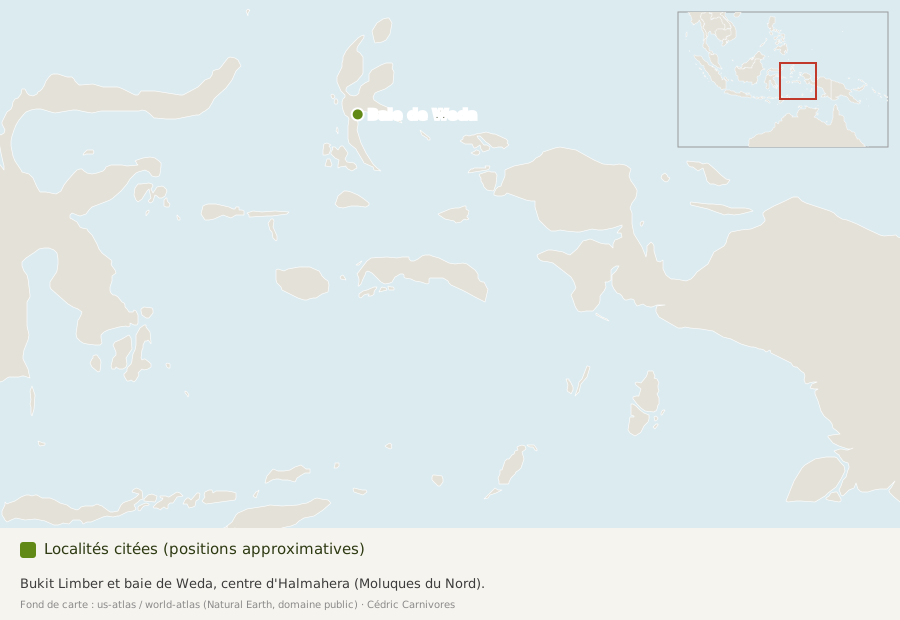
Endemic to Halmahera: Bukit Limber and Weda Bay, in the centre of the island, from 415 to 1,014 m.
Habitat
Lower montane forest on ultramafic rocks. According to Mansur and Brearley (2024), at Weda Bay (Halmahera), the site of a large nickel mining complex: described in 2015 in little-disturbed forest on metal-rich ultramafic soils, it also grows in open, disturbed lowland scrub, within the mining concession (46 plants per 1,000 m²). Its leaves are poor in phosphorus and calcium; its prey are mainly yellow crazy ants, and its pitchers harbour mosquito and fly larvae. “Critically endangered”: the authors call for urgent measures.
Sources
- Wikipedia (English), Nepenthes weda: publication, range, altitude, habitat.
- Wikipedia (English), Nepenthes halmahera: same article.
- “Ecological observations on Nepenthes weda on the island of Halmahera”, Edinburgh Journal of Botany, 2024 (open licence): ecology, prey, conservation.
- Cheek, “Nepenthes (Nepenthaceae) of Halmahera, Indonesia”, Blumea 59, 2015 (Naturalis open repository): original description, ecology, conservation.
- GBIF, Nepenthes weda: author, original publication, countries and localities of herbarium specimens and observations.