Nepenthes × trusmadiensis Marabini
Natural hybrid sheet, 29/10/2026.
At a glance
| Scientific name | Nepenthes × trusmadiensis Johannes Marabini, Mitteilungen der Botanischen Staatssammlung München, 1983 |
| Parents | N. lowii × N. macrophylla |
| Common names | Trus Madi pitcher-plant |
| Distribution | Summit ridge of Mount Trusmadi, Sabah (Borneo) |
| Habitat | Montane forest, from 2,500 to 2,600 m |
| Status | Critically endangered (IUCN) |
Etymology
- trusmadiensis: “from Mount Trusmadi”, the only mountain where it grows.
History of the discovery
- 1983: Johannes Marabini and John Briggs discovered it on Mount Trusmadi. On site, Briggs thought it was a cross between N. lowii and N. edwardsiana.
- 1983: Marabini described it the same year.
Description (how to recognise it)
- Pitchers among the largest in Borneo: up to 35 cm high, intermediate in shape between its parents.
- Lid: held away from the mouth, with short bristles underneath, inherited from N. lowii.
- Peristome: ribbed and toothed, but less so than that of N. macrophylla.
- Leaves: petiolate, up to 50 cm.
- Habit: a climbing stem, but the plant stays modest in size despite its large pitchers.
- Flowers: in clusters up to 50 cm long.
Distribution
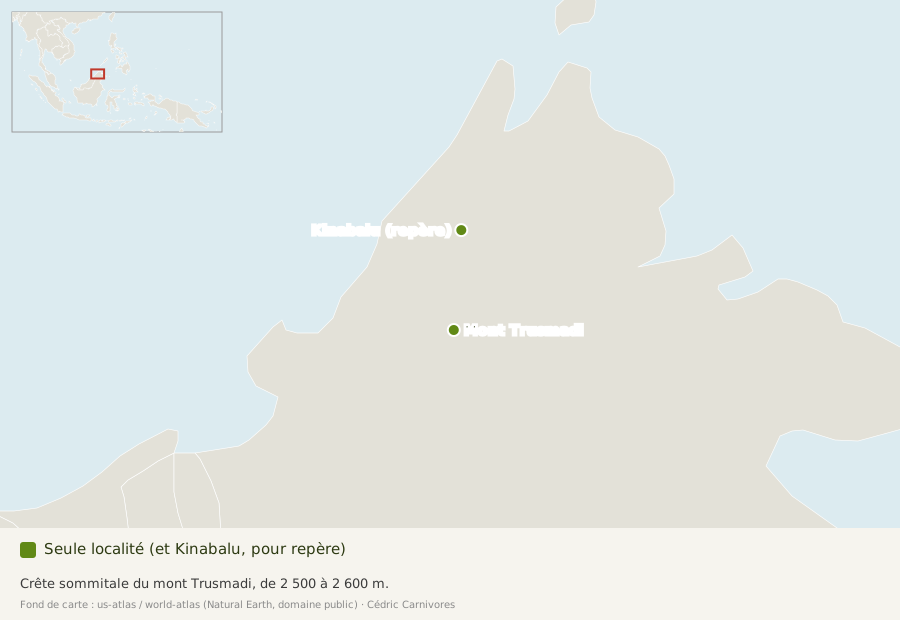
Limited to the summit ridge of Mount Trusmadi, between 2,500 and 2,600 m, where its two parents grow together.
Threats and protection
Critically endangered according to the IUCN.
Did you know?
- It arose from the natural cross between N. lowii, the treeshrews' toilet pitcher, and N. macrophylla, with its giant leaves.
Sources
- Wikipedia (English), Nepenthes × trusmadiensis: parents, 1983 discovery (Marabini and Briggs), 1983 description, range, altitude, description, status.