Philcoxia rhizomatosa Scatigna et al.
Species sheet, updated on 29/10/2026.
At a glance
| Scientific name | Philcoxia rhizomatosa Scatigna et al., Phytotaxa, 2015 |
| Family | Plantaginaceae |
| Distribution | Botumirim, Minas Gerais (Brazil) |
| Habitat | Sandy outcrop, between cerrado and caatinga |
Etymology
- Philcoxia: see the genus sheet.
- rhizomatosa: “with a rhizome”, for its underground stems (probable meaning, not confirmed).
Description (how to recognise it)
- Perennial herb with a clearly visible, thick (1.4 to 2.5 mm) and branched rhizome, with marked nodes (hence its name), a feature unique in the genus; leaves underground when young, then lying on the soil surface; blade peltate, round to kidney-shaped, up to 7 mm, the largest in the genus (1.5 to 3 mm in the others), glandular on top.
- Inflorescence 15 to 30 cm, the only one in the genus that is entirely hairless (including pedicels and calyx).
Distribution
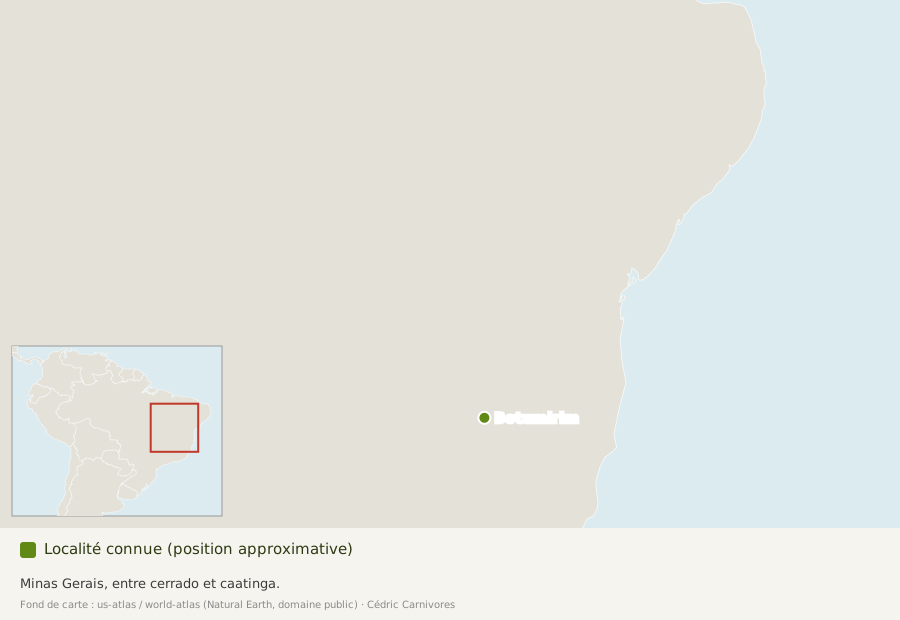
Possibly endemic to one sandy outcrop in the municipality of Botumirim (Minas Gerais), in the transition vegetation between cerrado and caatinga. According to Kew's world checklist of plants (WCVP), it is native to this single region: southeastern Brazil. According to Flora do Brasil (the official list of Brazilian plants), it is endemic to Brazil and grows in this state: Minas Gerais. Major biomes: Caatinga and Cerrado.
Habitat
According to Flora do Brasil: terrestrial plant, in campos rupestres (rocky mountain grasslands). Known from a single site: the edge of a patch of deep white quartzite sand, about 2,000 m², in cerrado and caatinga vegetation surrounded by a eucalyptus plantation, at Botumirim (Minas Gerais), at about 820 m; at least ten plants, which multiply by their rhizomes; in flower in December and March. “Critically endangered”: sand extraction for construction and expansion of the eucalyptus.
Sources
- FAPESP, Philcoxia rhizomatosa: 2015 description, locality, habitat.
- Kew, World Checklist of Vascular Plants (via GBIF): natural distribution.
- Flora e Funga do Brasil, official list (via GBIF): states, biomes, endemism, life form and vegetation types in Brazil.
- “Philcoxia rhizomatosa : a new carnivorous species from Minas Gerais, Brazil” (Plazi text, public domain, via GBIF): original description, habitat, conservation.