Pinguicula agnata Casper
Species sheet, updated on 30/10/2026.
At a glance
| Scientific name | Pinguicula agnata Siegfried Jost Casper, Feddes Repertorium 67, 1963 |
| Family | Lentibulariaceae (section Agnata) |
| Distribution | Hidalgo (Zimapán district) and Querétaro (Mexico) |
| Habitat | Dry, almost vertical, north-facing limestone cliffs and slopes, from 850 to 1,524 m |
Etymology
- Pinguicula: see the genus sheet.
- agnata: from the Latin, “related” (general meaning of the word: reason for the name, not confirmed).
Description (how to recognise it)
- A rosette of 8 to 12 bright green, spatula-shaped leaves, 2.5 to 7 cm long, sticky on both sides in some forms.
- Flowers 1.8 to 2.2 cm, with a short, blunt spur (2 to 5 mm), white, purple or almost white in the wild.
- In winter, small hairy, non-carnivorous leaves.
Cultivated forms
| Form | Special feature |
|---|---|
| 'El Lobo' | red leaf edges, white flowers; from a population in Querétaro |
| 'CSUF' | scented flowers, glands on both sides; parent of many hybrids |
Distribution
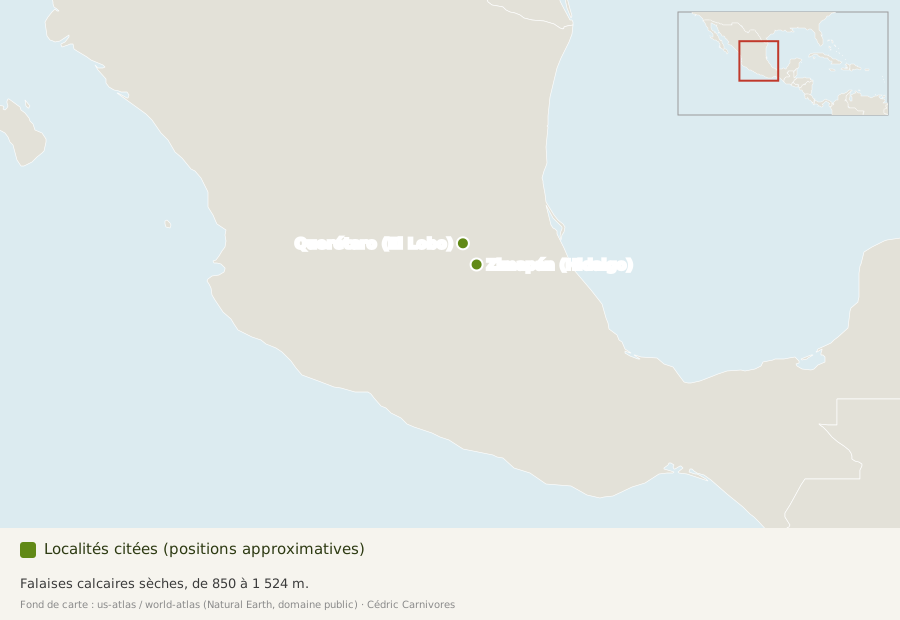
Mexico: Hidalgo (Zimapán district, type locality at 1,524 m; another site at 850-950 m) and Querétaro (between two villages, form 'El Lobo'). A record from Tamaulipas is doubted.
Habitat
Dry, rocky limestone cliffs and slopes, almost vertical, facing north; surprisingly, it grows with cacti and agaves.
Relationships
Several closely related plants are now separate species, such as P. gigantea.
Sources
- pinguicula.org, P. agnata: Casper 1963, description, colours, cultivated forms, range, altitudes, habitat, relationships.