Pinguicula albida Wright ex Griseb.
Species sheet, updated on 30/10/2026.
At a glance
| Scientific name | Pinguicula albida Charles Wright ex August Grisebach, Catalogus Plantarum Cubensium, 1866 |
| Family | Lentibulariaceae (section Agnata) |
| Distribution | Western Cuba (Pinar del Río, Cordillera de Guaniguanico); also between Moa and Baracoa |
| Habitat | Deep shade under young palms, riverbanks, on siliceous sand or laterite |
| Status | Less threatened than P. filifolia |
Photos in the wild
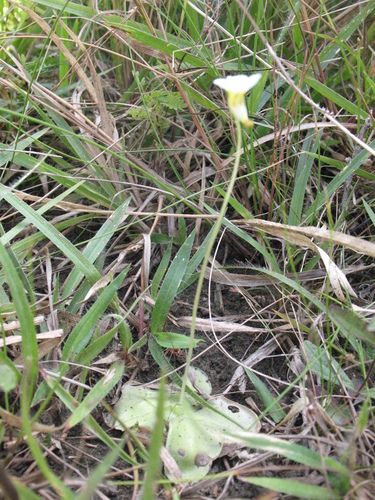
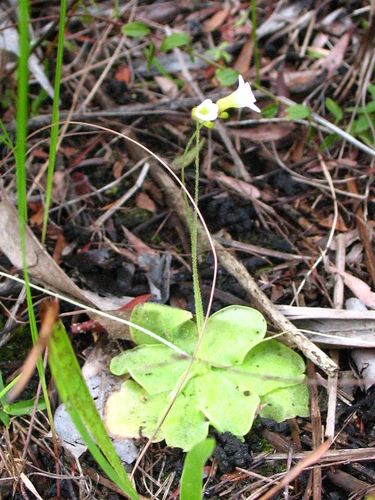
Etymology
- Pinguicula: see the genus sheet.
- albida: from the Latin, “whitish”, probably for its flowers (not confirmed).
Description (how to recognise it)
- A rosette of 4 to 12 yellow-green, very thin, membranous leaves, 1 to 4.5 cm long: so thin that dew forms underneath them.
- Small whitish to pinkish-white flowers 7 to 15 mm across.
- It can flower while still very small.
Distribution
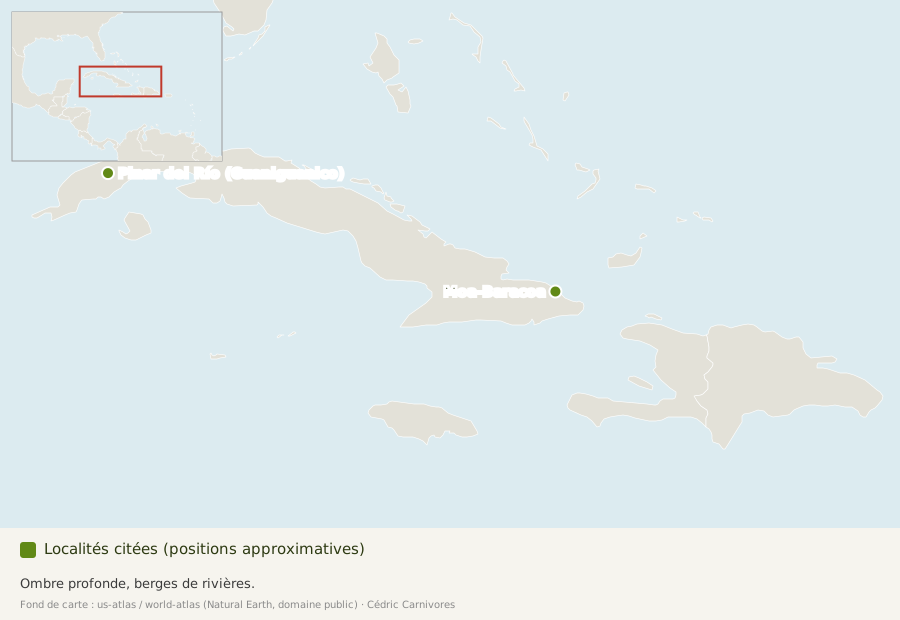
Western Cuba: mainly Pinar del Río and the Cordillera de Guaniguanico; also in the east, between Moa and Baracoa. The eastern plants (“Oriente type”) were described in 2003 as P. jaraguana.
Habitat
In small groups, in deep shade under young palms, often on shaded riverbanks; on fine siliceous sand lying over black peat, or on red laterite soils. It grows near Drosera capillaris.
Ecology
In the wild, it behaves as an annual, depending on shade and on the very high humidity of the rainy season.
Sources
- pinguicula.org, P. albida: Wright ex Grisebach 1866, description, range, P. jaraguana, habitat, life cycle, threats.