Pinguicula arvetii P. A. Genty
Species sheet, updated on 29/10/2026.
At a glance
| Scientific name | Pinguicula arvetii Paul André Genty |
| Common name | Arvet-Touvet's butterwort; in French grassette d'Arvet-Touvet |
| Family | Lentibulariaceae |
| Distribution | South-western Alps (France, Italy); recently found in Savoie |
| Habitat | Wet grassland and springs at altitude, on poor, non-calcareous soil, above about 1,300 m (1,800-2,600 m according to a French sheet) |
Etymology
- Pinguicula: see the genus sheet.
- arvetii: in honour of the Dauphiné botanist Casimir Arvet-Touvet (first name, not confirmed).
History
Long confused with P. leptoceras, it was reinstated as a species by Flora Gallica in 2014. In 2025, a study reported it in Savoie, in the Vallon de la Lombarde at Bessans, further north than its known range.
Description (how to recognise it)
- A perennial plant 5 to 8.5 cm tall, with slender scapes.
- Leaves oval-oblong.
- Violet flowers, 12 to 19 mm, with a spur curved downwards, as long as a third of the corolla: proportionally longer than in P. leptoceras.
- Flowering: June-July.
Distribution
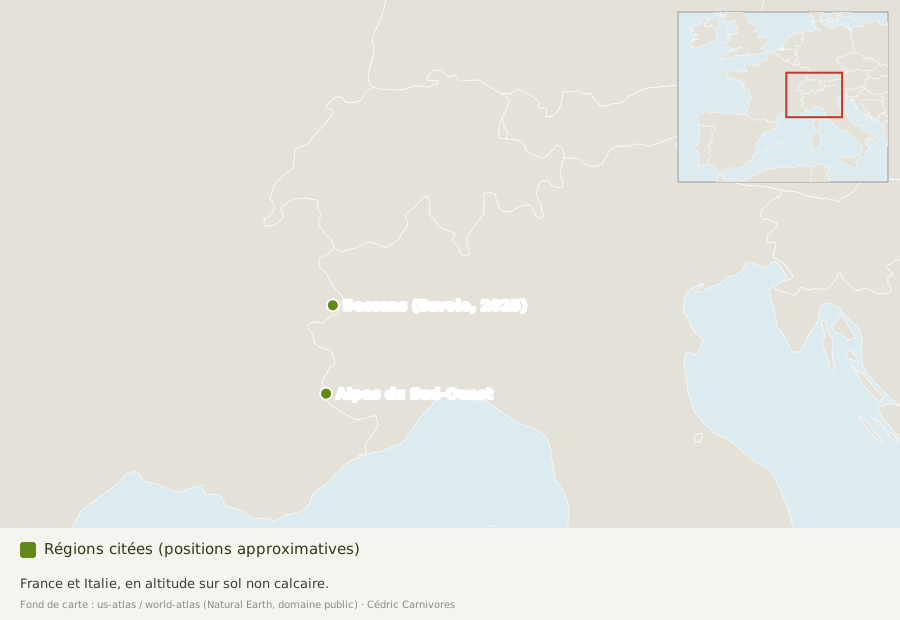
South-western Alps, in France and Italy; also in Savoie (Bessans).
Habitat
A study in the western Alps shows that it lives higher up than P. vulgaris, with plants of snowbeds, scree and poor sandy grassland; on non-calcareous, poor and less wet soils, colder and sunnier. A French sheet mentions wet grassland and springs between 1,800 and 2,600 m.
Sources
- Kew, Plants of the World Online: author, countries.
- Habitat study, Plant Ecology and Evolution 149(1), 2016: habitat compared with P. vulgaris.
- Dionée sheet, P. arvetii: description, flowering, altitude, difference from P. leptoceras.
- Blanchemain & Delahaye 2025, Vanoise National Park: discovery in Savoie.