Pinguicula benedicta Barnhart
Species sheet, updated on 30/10/2026.
At a glance
| Scientific name | Pinguicula benedicta John Hendley Barnhart, Memoirs of the Torrey Botanical Club 16, 1920 |
| Family | Lentibulariaceae (section Agnata) |
| Distribution | Moa-Baracoa region, eastern Cuba |
| Habitat | Steep rocky banks of the Río Jaguaní, on almost pure laterite, at altitude |
| Status | Threatened by mining pollution |
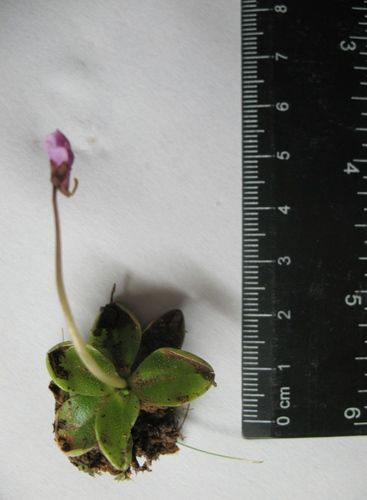
Photos in the wild
Etymology
- Pinguicula: see the genus sheet.
- benedicta: from the Latin, “blessed”; perhaps linked to Camp San Benito, one of its localities (not confirmed).
History
Discovered in 1910 by the collector Shafer, it was described ten years later by Barnhart.
Description (how to recognise it)
- A dense rosette of small green leaves, 1 to 1.5 cm long.
- Dark blue flowers 1.5 to 1.8 cm across, on stems 7 to 11 cm tall. No hibernaculum.
Distribution
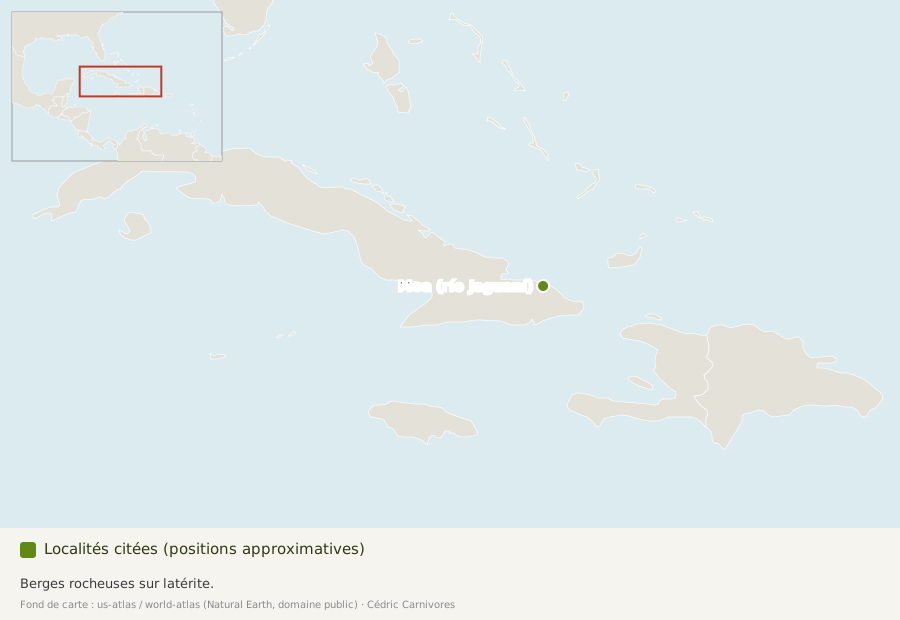
Eastern Cuba, Moa-Baracoa region: trail from Camp La Barga to Camp San Benito, Minas de Yberia, the Río Yagrumaje area near Moa.
Habitat
Steep rocky banks of the Río Jaguaní, a fast mountain stream, about 1 m above the water, on a strip one metre wide. It grows on almost pure laterite, toxic to most plants.
Threats
Air pollution from nickel processing, possibly a source of acid rain; in the future, mining and logging.
Did you know?
- The Moa-Baracoa region is the largest centre of plant endemism in Cuba: 365 endemic taxa out of 967.
Sources
- pinguicula.org, P. benedicta: Barnhart 1920, Shafer 1910, description, range, habitat, laterite, threats, Moa-Baracoa endemism.