Pinguicula casabitoana J. Jiménez Alm.
Species sheet, updated on 30/10/2026.
At a glance
| Scientific name | Pinguicula casabitoana José de Jesús Jiménez Almonte, 1960 |
| Synonym | P. cladophila Ernst |
| Common name | In French “Grassette de Casabito” |
| Family | Lentibulariaceae (section Discoradix) |
| Distribution | Cordillera Central (Dominican Republic) |
| Habitat | Mountain cloud forests, mainly on trees |
| Status | Critically endangered |
Photos in the wild
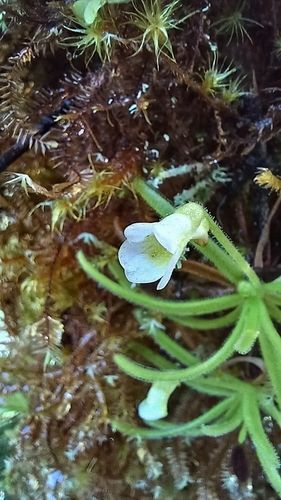
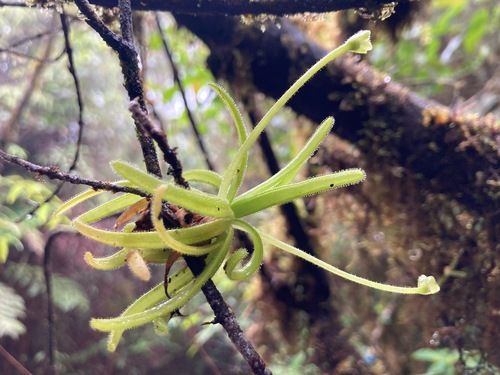
Etymology
- Pinguicula: see the genus sheet.
- casabitoana: “of Casabito”, a massif of the Cordillera Central (probable meaning, not confirmed).
A tree-dwelling butterwort
It is one of the only two truly epiphytic butterworts of the Greater Antilles, together with P. lignicola from Cuba: it grows on the trees of cloud forests.
Description (how to recognise it)
- Like P. lignicola (Cuba), to which it is very close, it is an obligate epiphytic butterwort from the Dominican Republic (Loma del Casabito, hence its name); Temple et al. (2020) showed that it is truly viviparous: its seeds germinate inside the calyx and it is the seedlings that disperse.
- The cotyledons stay inside the seed coat (“cryptocotylar” germination), a first in Pinguicula.
Distribution
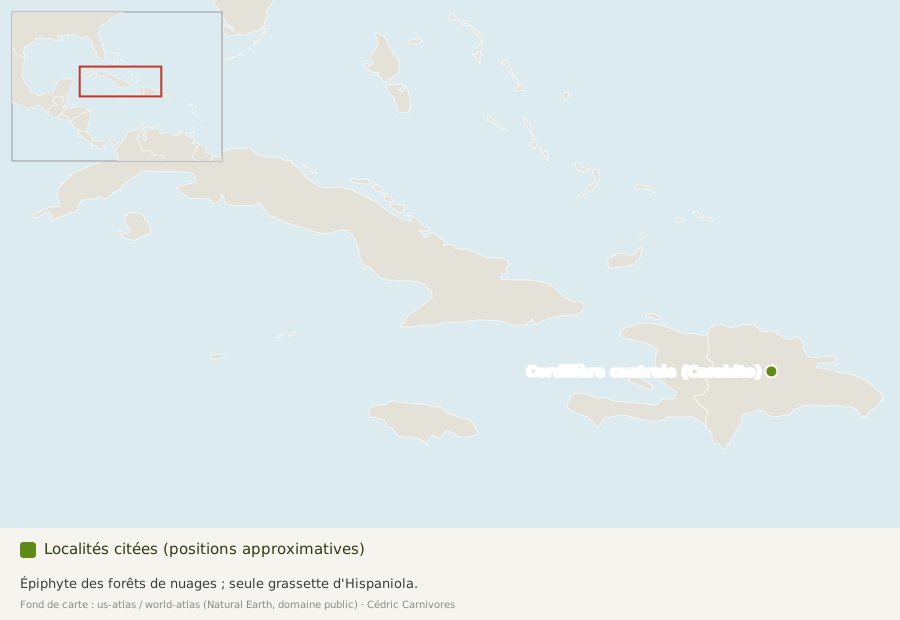
Endemic to the Dominican Republic: a few localities, all in the Cordillera Central. It is the only butterwort on Hispaniola.
Habitat
According to Temple et al. (2020), it lives on trees in constantly damp micro-habitats, wetted by clouds and rain, on Loma del Casabito.
Threats and protection
“Critically endangered”. Its tiny range makes it very vulnerable to habitat destruction.
Sources
- Wikipedia (English), Pinguicula casabitoana: author, 1960, synonym, range, habitat, epiphyte, status.
- Web search (monograph of the butterworts of the Greater Antilles): two epiphytic species, a single species on Hispaniola.
- Wikipedia (English), Pinguicula: threat to species with a small range.
- Temple et al., “True vivipary in two remarkable Pinguicula from the Caribbean, P. lignicola and P. casabitoana”, 2020, Carnivorous Plant Newsletter (ICPS open archive): epiphytic way of life, vivipary.