Pinguicula chilensis Clos
Species sheet, updated on 30/10/2026.
At a glance
| Scientific name | Pinguicula chilensis Dominique Clos, in Claude Gay, Flora Chilena 4: 365, 1849 |
| Family | Lentibulariaceae (subgenus Temnoceras, section Ampullipalatum) |
| Distribution | Andes of Chile and Argentina (from about 36° to 48° S) |
| Habitat | Mountains, collections between 950 and 2,350 m (GBIF) |
Etymology
- Pinguicula: see the genus sheet.
- chilensis: from the Latin, “of Chile”.
Description (how to recognise it)
- According to Gluch (2007), in Nahuelbuta National Park: rosettes 5 to 8 cm across in summer, smaller and yellowish red in the sun; no winter bud (hibernaculum), like the other temperate butterworts of South America.
- Scapes 2 cm at most, with 1 or 2 flowers (3 at most); corolla lobes almost equal, obovate, slightly notched; palate in two parts, with long yellow hairs, placed near the tip of the middle lobe of the lower lip, which distinguishes it from P. antarctica. In flower from late December to February.
- Note, identity debated: according to Casper (2020), the butterworts of the Cordillera de Nahuelbuta long called P. chilensis (including those observed by Gluch in 2007) belong to P. nahuelbutensis, while the P. chilensis described in Gay's flora would be a synonym of P. antarctica.
Distribution
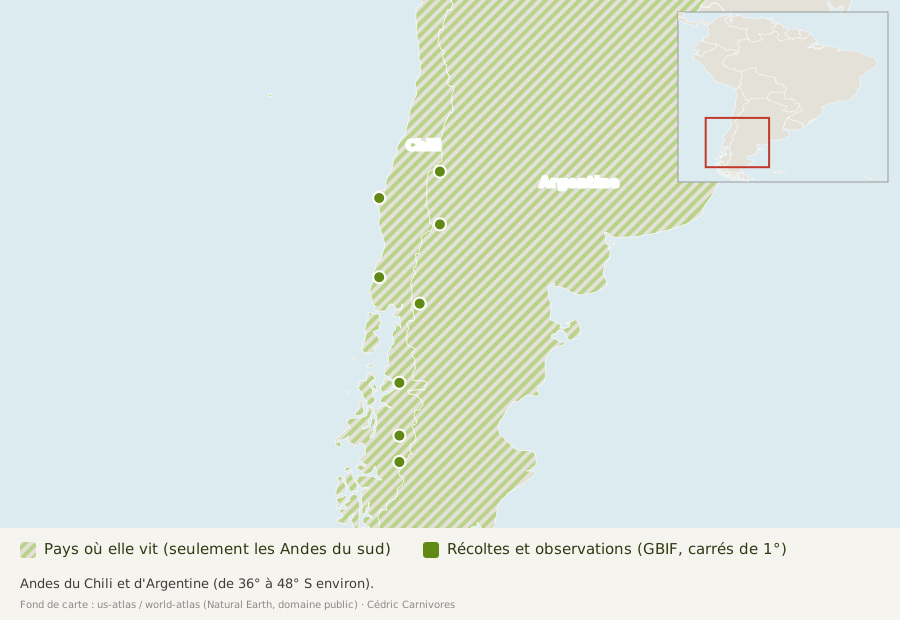
Southern Andes, on both sides of the border between Chile and Argentina, from about 36° S (Neuquén, Biobío) to 48° S (Aysén) (GBIF). An isolated record from Colombia is discarded. According to Kew's world checklist of plants (WCVP), it is native to the following regions: southern Argentina, central Chile and southern Chile.
Habitat
According to Gluch (2007), citing Casper (1966), it grows in the Andes of Chile (from 35° to 38° S) in wet meadows (“mallines”) at the edge of snowfields on volcanoes and high mountains, from 1,700 to 3,000 m, and also in the coastal range. In Nahuelbuta, in an araucaria forest, he saw it near springs, among mosses in the shade (at about 1,260 m), and above all on the Las Turberas plateau (1,250 m), a kind of bog without sphagnum formed by streams, in the shade of grasses, with Drosera uniflora.
Sources
- List of Pinguicula: section, author.
- Kew, World Checklist of Vascular Plants (via GBIF): natural distribution.
- Gluch, Carnivorous Plant Newsletter 36, 2007 (archive.org): field observations in Chile.
- Casper, “Pinguicula antarctica Vahl and/or Pinguicula nahuelbutensis Gluch in the Cordillera de Nahuelbuta”, 2020, Carnivorous Plant Newsletter (ICPS open archive): identity of the Nahuelbuta butterworts, habitat.
- GBIF, Pinguicula chilensis: author, original publication, countries and localities of herbarium specimens and observations.