Pinguicula chuquisacensis S. Beck, A. Fleischm. & Borsch
Species sheet, updated on 30/10/2026.
At a glance
| Scientific name | Pinguicula chuquisacensis Stephan G. Beck, Andreas Fleischmann & Thomas Borsch, Willdenowia 38, 2008 |
| Family | Lentibulariaceae (section not specified in our list) |
| Distribution | Bolivia: Nuevo Mundo valley, north-east of Villa Serrano (Chuquisaca) |
| Habitat | Acid sandstone cliff often in fog, at around 2,400 m |
| Status | “Critically endangered” (CR) classification proposed by its authors |
Etymology
- Pinguicula: see the genus sheet.
- chuquisacensis: from the department of Chuquisaca, in Bolivia, where it lives.
History of the description
- 2008: Beck, Fleischmann and Borsch describe it in the journal Willdenowia.
- GBIF regards it as a synonym of P. jarmilae Halda & Malina, described a year earlier (2007) in Bolivia. Our list keeps it separate, as an “unplaced” species (incertae sedis).
Description (how to recognise it)
- A rosette plant with 4 to 6 oblong to oval leaves, pressed flat against the rock.
- No winter bud (hibernaculum).
- Small flowers 13 to 15 mm, spur included (2 to 3 mm), in July; fruits in November.
- Genetically, its closest relatives are P. involuta and P. calyptrata.
Distribution
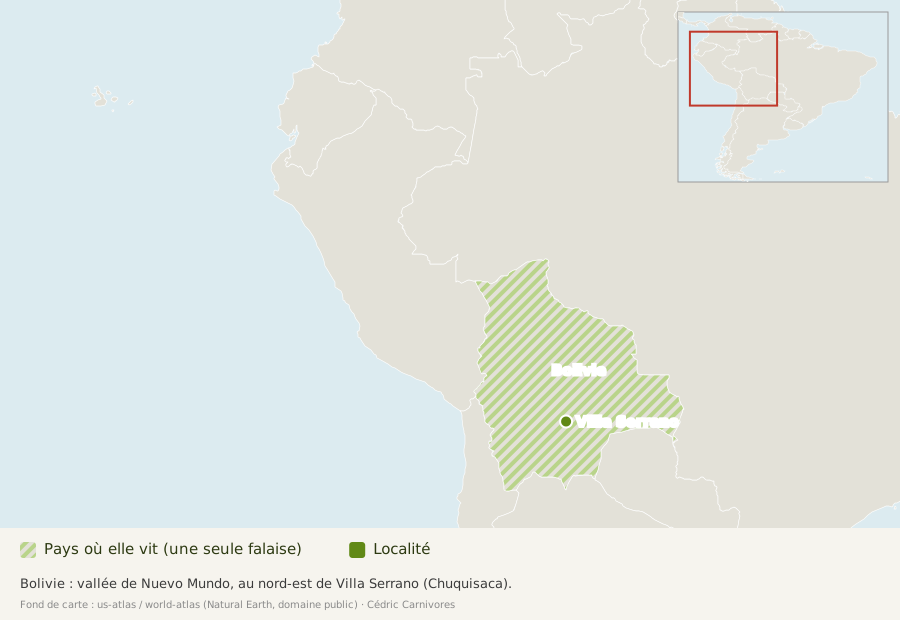
Endemic to Bolivia: a single rock face in the Nuevo Mundo valley, north-east of Villa Serrano (department of Chuquisaca).
Habitat
Acid sandstone often shrouded in fog, in the open, at around 2,400 m.
Threats and protection
Its authors recommend the “critically endangered” classification: tiny range and threats to the surroundings of the cliff.
Sources
- Wikipedia (English), Pinguicula chuquisacensis: authors, year, description, flowering, relationships, range, altitude, habitat, proposed status.
- List of Pinguicula: incertae sedis status.
- GBIF, Pinguicula chuquisacensis: GBIF treats this name as a synonym of P. jarmilae; collections from Bolivia.