Pinguicula conzattii Zamudio & van Marm
Species sheet, updated on 30/10/2026.
At a glance
| Scientific name | Pinguicula conzattii Sergio Zamudio & Joost van Marm, Acta Botanica Mexicana 62: 16, 2003 |
| Family | Lentibulariaceae (subgenus Isoloba, section Heterophyllum) |
| Distribution | Oaxaca (Mexico): near Santiago Nuyoo, Tlaxiaco district |
| Habitat | Well-shaded vertical rock faces, at around 2,500 to 2,700 m |
Etymology
- Pinguicula: see the genus sheet.
- conzattii: in honour of Cassiano Conzatti, an Italian-born botanist who spent most of his life in Mexico.
History of the description
2003: Zamudio and van Marm describe it. It is close to P. mirandae.
Description (how to recognise it)
- A perennial rosette plant, with stiff, rounded leaves pressed flat to the ground, 28 to 50 mm long, on a petiole of 10 to 20 mm.
- Leaves covered with sticky glands and digestive glands.
- Winter rosette of short, non-carnivorous leaves, hairy on both sides: this is what sets it apart.
- White to violet flowers, in November, at the start of the winter rosette.
Distribution
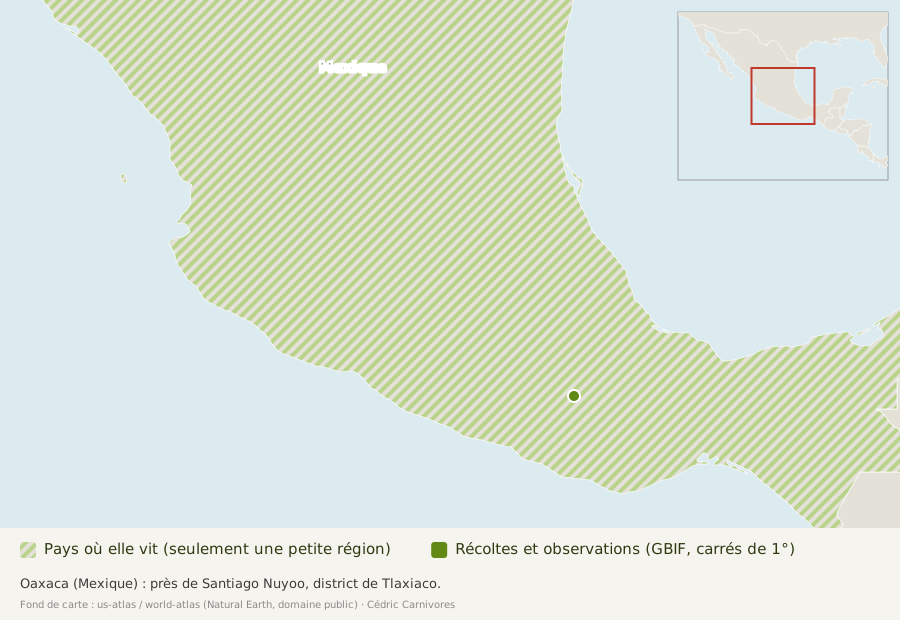
Known only around its type locality, near Santiago Nuyoo (Tlaxiaco district, Oaxaca, Mexico).
Habitat
Well-shaded vertical rock faces, at around 2,700 m (GBIF: collections between 2,500 and 2,700 m).
Ecology
In the dry season, when prey becomes scarce, it forms a non-carnivorous winter rosette that saves its energy.
Threats and protection
Its range seems extremely small, but the species is still poorly known.
Sources
- Wikipedia (English), Pinguicula conzattii: range, altitude, habitat, description, etymology, relationships.
- List of Pinguicula: section.
- GBIF, Pinguicula conzattii: author, original publication, countries and localities of herbarium specimens and observations.