Pinguicula crystallina Sm.
Species sheet, updated on 29/10/2026.
At a glance
| Scientific name | Pinguicula crystallina James Edward Smith |
| Common name | Cyprus butterwort; in French grassette de Chypre |
| Family | Lentibulariaceae (section Cardiophyllum) |
| Distribution | Cyprus (Troodos massif, Limassol forest); perhaps also Anatolia (Turkey) |
| Habitat | Volcanic soil near waterfalls and springs |
| Status | Vulnerable (Red Data Book of the flora of Cyprus) |
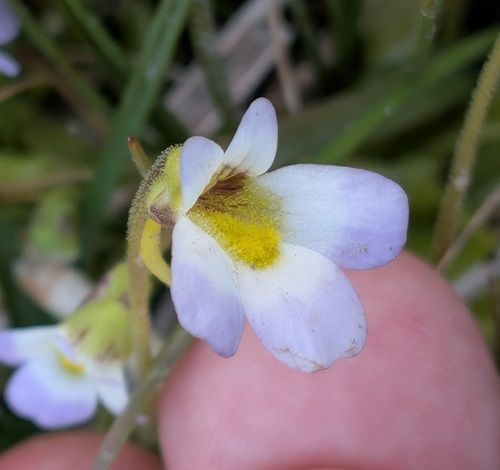
Photos in the wild
Etymology
- Pinguicula: see the genus sheet.
- crystallina: from the Latin, “crystalline” (probably for the shiny look of its leaves, not confirmed).
Distribution
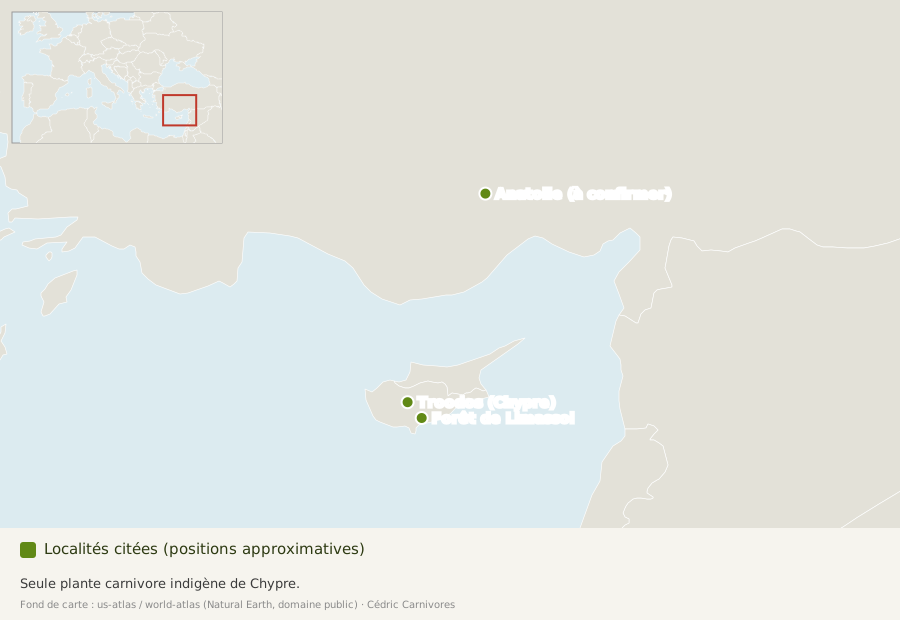
- Cyprus: seven sites known in the Troodos National Forest Park and one in the Limassol forest.
- Kew gives it only for Cyprus; a Cypriot blog says it also occurs in Anatolia (Turkey).
Habitat
Volcanic soil beside waterfalls and springs.
A species complex
Together with P. hirtiflora, it forms a complex that is hard to untangle, from southern Italy to the Balkans, Greece, Cyprus and Turkey: some characters used to separate them have proved unreliable (Fleischmann, Carnivorous Plant Newsletter 44(2)). The flora of Greece in fact treats hirtiflora as a subspecies of crystallina.
Threats and protection
“Vulnerable” according to the Red Data Book of Cyprus. Drought, which dries out its habitats, is the main threat.
Did you know?
- It is the only carnivorous plant native to Cyprus.
Sources
- Cyprus Mail, 2021: only carnivorous plant of Cyprus, sites, habitat, status, threat.
- Kew, Plants of the World Online: range.
- Biodiversity Cyprus: presence in Anatolia.
- Fleischmann, The intricate Pinguicula crystallina/hirtiflora-complex, CPN 44(2): species complex.
- Flora of Greece: P. crystallina subsp. hirtiflora.