Pinguicula elizabethiae Zamudio
Species sheet, updated on 30/10/2026.
At a glance
| Scientific name | Pinguicula elizabethiae Sergio Zamudio, Acta Botanica Mexicana 47, 1999 |
| Family | Lentibulariaceae (section Orcheosanthus) |
| Distribution | Río Moctezuma canyon (Hidalgo) and around San Joaquín (Querétaro, Mexico) |
| Habitat | Very steep slopes of calcareous mudstone in foothill scrub, from 1,000 to 1,600 m |
Etymology
- Pinguicula: see the genus sheet.
- elizabethiae: in honour of Elizabeth Argüelles, a botanist who studied the flora of Querétaro, a friend of the author.
History of the discovery
Found in 1990 during the ecological studies for the Zimapán dam project in the Moctezuma canyon, the same studies that led to the discovery of P. moctezumae. First taken for P. cyclosecta, it was described in 1999.
Description (how to recognise it)
- Winter rosette: 60 to 125 small spatula-shaped leaves, fringed with long cilia.
- Carnivorous summer leaves, almost round, 3.5 to 7 cm.
- Bright red-purple flowers 3.6 to 4.6 cm across, with a spur of 1.5 to 2.8 cm, very similar to those of P. colimensis.
Distribution
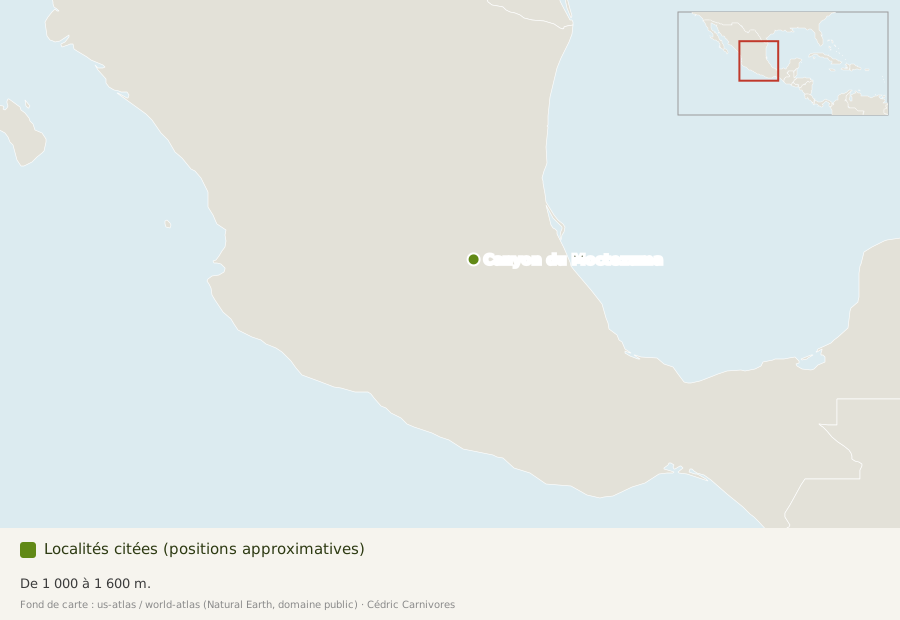
Río Moctezuma canyon (Hidalgo) and around San Joaquín (Cadereyta, Querétaro), from 1,000 to 1,600 m.
Habitat
Very steep slopes of calcareous mudstone, in foothill scrub, among mosses, the spikemoss Selaginella lepidophylla and small ferns (Notholaena, Cheilanthes).
Relationships
Close to P. colimensis and P. cyclosecta.
Sources
- pinguicula.org, P. elizabethiae: Zamudio 1999, etymology, discovery, description, range, altitude, habitat, relationships.