Pinguicula fiorii Tammaro & Pace
Species sheet, updated on 29/10/2026.
At a glance
| Scientific name | Pinguicula fiorii Fernando Tammaro & Loretta Pace, Informatore Botanico Italiano 19, 1987 |
| Family | Lentibulariaceae |
| Distribution | Majella massif (Abruzzo, Italy) |
| Habitat | Mossy, dripping limestone rocks in gorges, in beech forest; up to an alpine rocky spur; from 750 to 2,470 m |
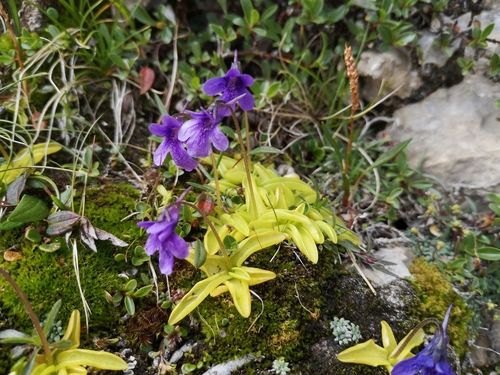
Photos in the wild
Etymology
- Pinguicula: see the genus sheet.
- fiorii: probably in honour of the Italian botanist Adriano Fiori (not confirmed).
Description (how to recognise it)
- A rosette of 7 to 8 broadly oval, sticky leaves, 2 to 3.2 cm long.
- A blue-violet flower of 15 to 20 mm on a scape of 5 to 7.5 cm; straight, blunt spur, a third as long as the corolla.
- Hibernaculum in winter; octoploid (2n = 32 according to the source).
Distribution
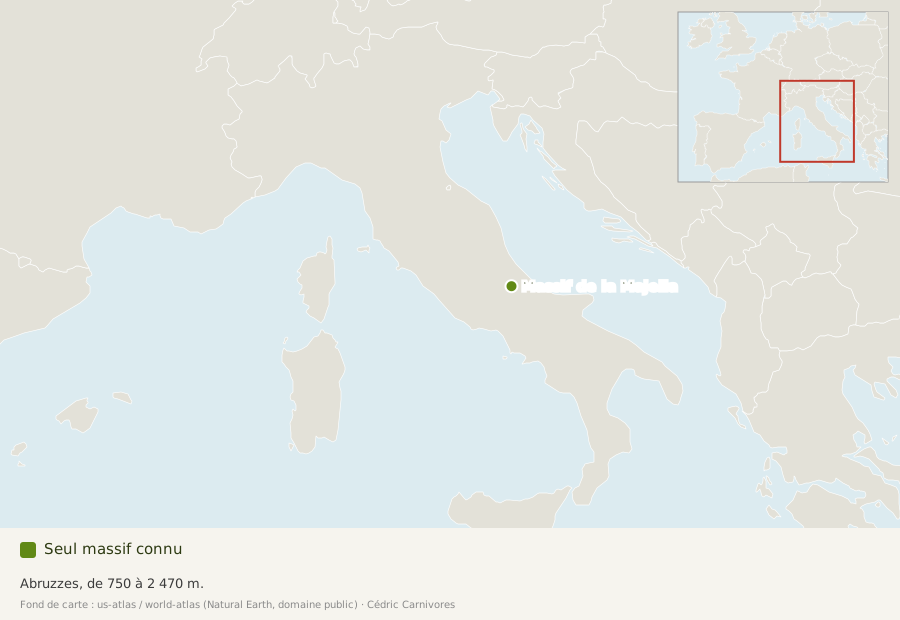
Endemic to the Majella massif: four sites known in 2002, probably more still to be found. The lowest is in the Valle dell'Orfento (750-800 m), the highest at about 2,460-2,470 m.
Habitat
- Mossy limestone rocks in dripping gorges, in beech forest;
- at the alpine site, on a rocky spur, where it gets its water mainly from night-time condensation and several hours of direct sun.
Threats
It is hard to find; colonies have disappeared when mats of moss slid off the cliffs. It was once mistaken for P. balcanica.
Sources
- pinguicula.org, P. fiorii: Tammaro & Pace 1987, description, range, sites, altitudes, habitat, threats, confusion.
- (2n = 32 and “octoploid”: the article on P. christinae lists it among the octoploids, which contradicts 2n = 32, not confirmed)