Pinguicula gigantea Luhrs
Species sheet, updated on 30/10/2026.
At a glance
| Scientific name | Pinguicula gigantea Hans Luhrs, Phytologia 79, December 1995 |
| Family | Lentibulariaceae (section Agnata) |
| Distribution | Near San Bartolomé Ayautla (Oaxaca, Mexico) |
| Habitat | Steep slopes and rock faces in full tropical sun, at about 350 m |
Etymology
- Pinguicula: see the genus sheet.
- gigantea: from the Latin, “giant”: one of the largest butterworts.
History
Alfred Lau discovers it and tells of his find in 1993; Hans Luhrs describes it in 1995.
Description (how to recognise it)
- A large rosette of half-upright, bright green leaves, up to 14.5 cm (16.5 at most) by 4 to 7 cm.
- Glands on both sides of the leaves: it traps insects on the upper and lower side alike, a rare trait (as in P. agnata and P. longifolia).
- Flowers of 2.8 to 3.3 cm, pale violet to whitish lilac, on stems of 10.5 to 18.5 cm.
- Leaves produced all year round.
Distribution
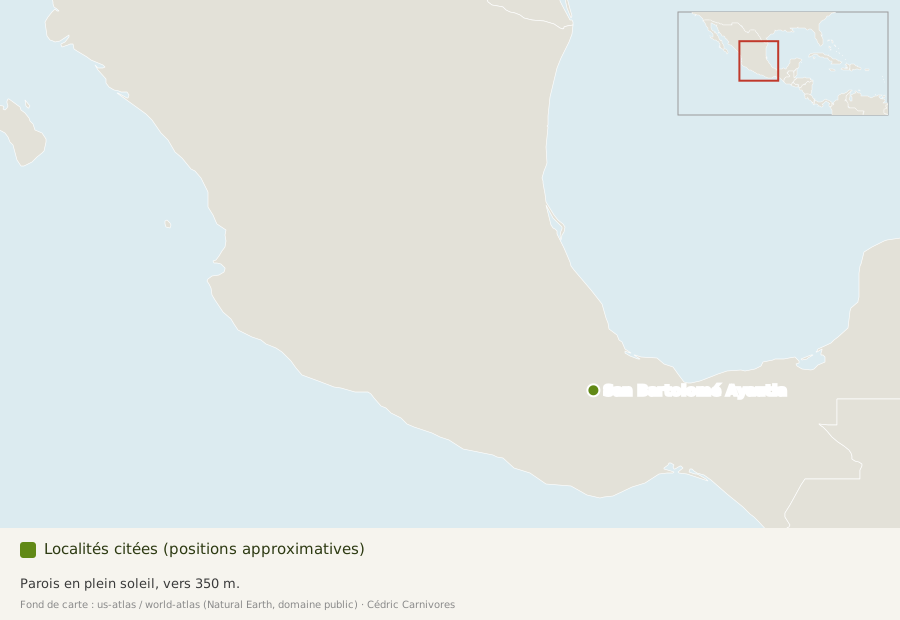
Near San Bartolomé Ayautla (Oaxaca), on south-facing rock faces along the río Uruapan, at about 350 m.
Habitat
Steep slopes and rock faces in full tropical sun, with Tillandsia streptophylla and Agave attenuata; about 3,000 mm of rain per year in the Cerro Rabón area.
Sources
- pinguicula.org, P. gigantea: Luhrs 1995, Lau 1993, description, glands on both sides, range, altitude, habitat, rainfall.