Pinguicula grandiflora Lam.
Species sheet, updated on 29/10/2026.
At a glance
| Scientific name | Pinguicula grandiflora Jean-Baptiste de Lamarck, 1789 |
| Common names | Large-flowered butterwort; in French grassette à grandes fleurs |
| Family | Lentibulariaceae |
| Distribution | France, Spain, Switzerland, Ireland; introduced in England and Wales |
Photos in the wild
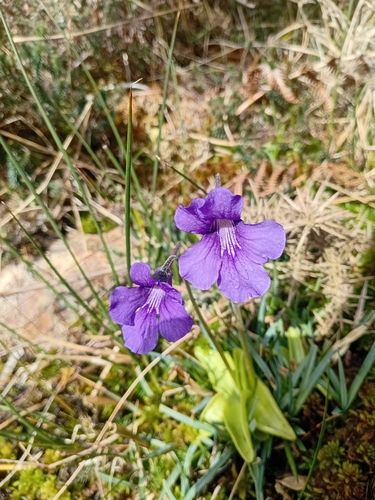
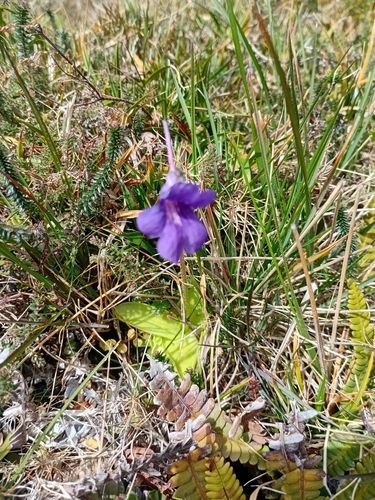
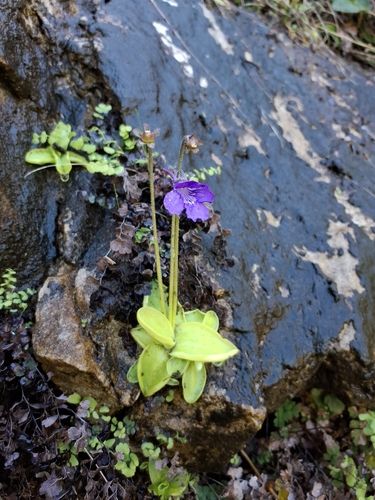
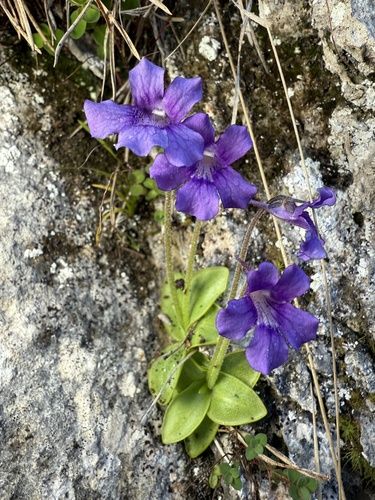
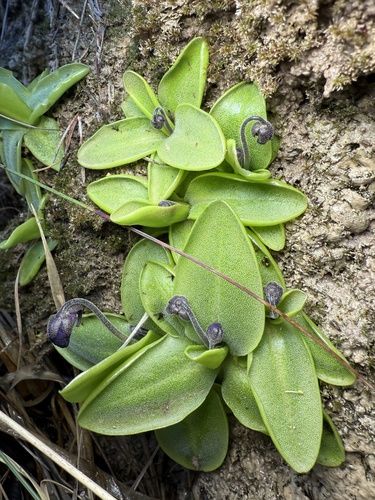
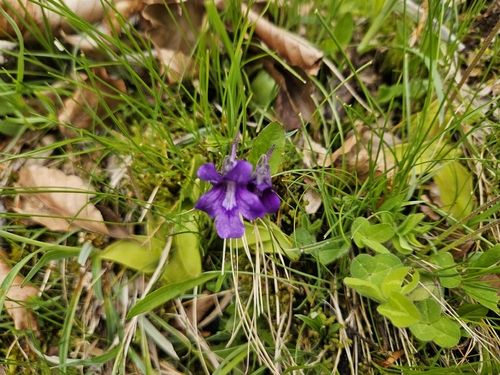
Etymology
- Pinguicula: see the genus sheet.
- grandiflora: from the Latin, “with large flowers”.
History of the description
The French naturalist Lamarck describes it in 1789. It has sometimes been treated as a subspecies of P. vulgaris.
Description (how to recognise it)
- Its flower is much larger than in most butterworts.
- According to Grenier and Godron (1850): corolla swollen, as wide as long, reaching 2 cm; lobes of both lips obovate, very wide and overlapping; spur linear and blunt, at least two thirds of the length of the corolla.
- Flowers violet, more rarely pink; they also describe a form longifolia with elongated leaves, narrowed into a petiole (Hautes-Pyrénées).
Subspecies
| Subspecies | Feature |
|---|---|
| subsp. grandiflora | type form |
| subsp. rosea (Mutel) Casper | pink flowers (not confirmed) |
Distribution
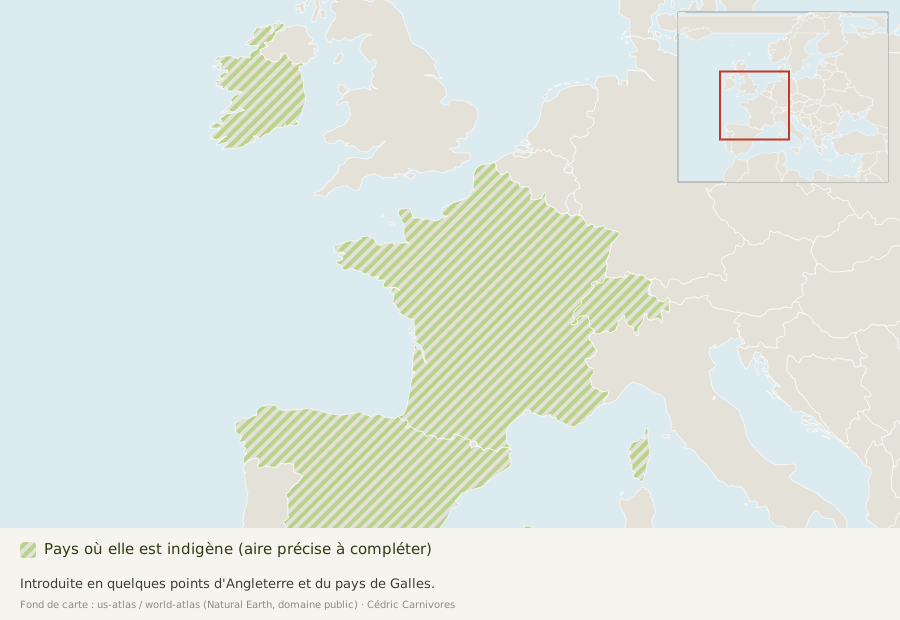
France, Spain, Switzerland and Ireland. It is not native to Great Britain, but has been introduced at a few places in England and Wales, as well as in Czechoslovakia. According to Kew's world list of plants (WCVP), it is native to the following regions: Czechia and Slovakia, France, Germany, Great Britain, Ireland, Spain and Switzerland.
Habitat
Grenier and Godron (1850) record it on the high summits of the Jura (from the Dôle to the Reculet), in the high regions of the Alps (Grenoble, Briançon, the Glandasse, the Lautaret), in the Pyrenees (Barèges, val d'Eyne, Prats-de-Mollo…) and in the Monts Dore and the Cantal; in flower in June-July.
Natural hybrids
With P. vulgaris: P. × scullyi (not confirmed; named hybrid from the genus list, not confirmed).
Sources
- Wikipedia (English), Pinguicula grandiflora: Lamarck 1789, name, flower, range, introductions, subspecies, synonyms.
- Genus list: P. × scullyi.
- Kew, World Checklist of Vascular Plants (via GBIF): natural distribution.
- Grenier and Godron, Flore de France II: Lentibulariées, 1850 (archive.org): description, localities and flowering.