Pinguicula gypsicola Brandegee
Species sheet, updated on 30/10/2026.
At a glance
| Scientific name | Pinguicula gypsicola Townshend Stith Brandegee, 1911 |
| Family | Lentibulariaceae (section Orcheosanthus) |
| Distribution | Minas de San Rafael, near Charcas (San Luis Potosí, Mexico) |
| Habitat | Moist gypsum rock, in the shade, in an arid climate |
Etymology
- Pinguicula: see the genus sheet.
- gypsicola: “that lives on gypsum” (probable meaning, from the Latin gypsum and -cola, not confirmed).
History of the description
Collected in 1910 by the collector Carl Albert Purpus, it is described by Brandegee in 1911. It came into cultivation around 1995.
Description (how to recognise it)
- Summer leaves: upright and very narrow, like straps, 4 to 7 cm long (up to 13 cm), pale green, very glandular.
- Winter rosette: dense, made of many small spoon-shaped leaves of 7 to 10 mm.
- Large violet-purple flowers of 3.4 to 4.2 cm, with a very long spur (1.8 to 3.1 cm).
Distribution
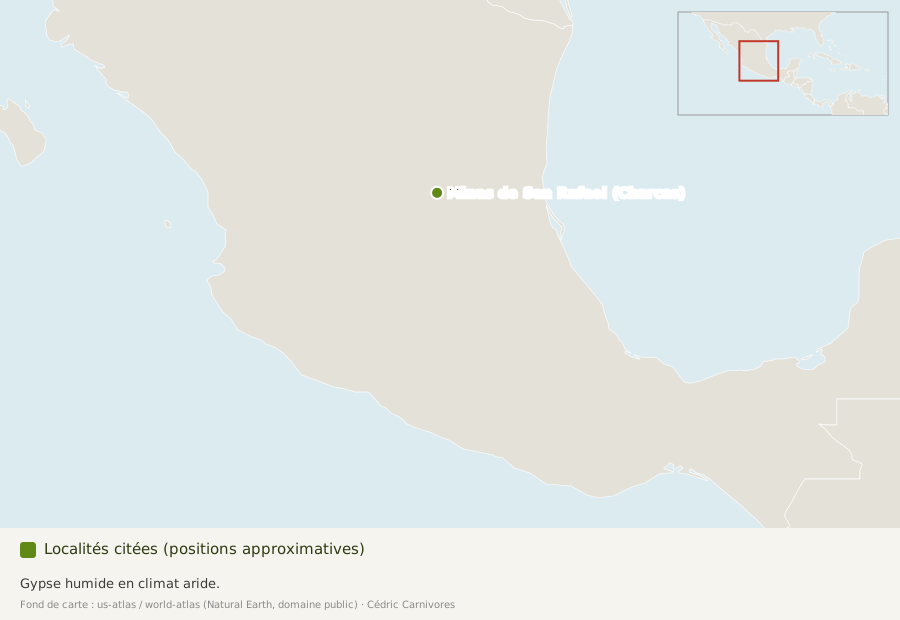
Known from the Minas de San Rafael, about 11 km south-east of Charcas (San Luis Potosí). Another form, “Santa Gertrudis”, grows about 56 km away.
Habitat
On moist gypsum rock, in the shade, with cacti, agaves (Agave stricta, A. striata), Dasylirion, Hechtia and spikemosses.
Ecology: a desert butterwort
- Arid climate: winters close to freezing, very rare rain, hot summers, but heavy dew at night.
- Carnivorous leaves in spring and summer; succulent, non-carnivorous rosette in winter, during the dry season.
Sources
- pinguicula.org, P. gypsicola: Brandegee 1911, Purpus 1910, description, range, habitat, companion plants, climate, life cycle.